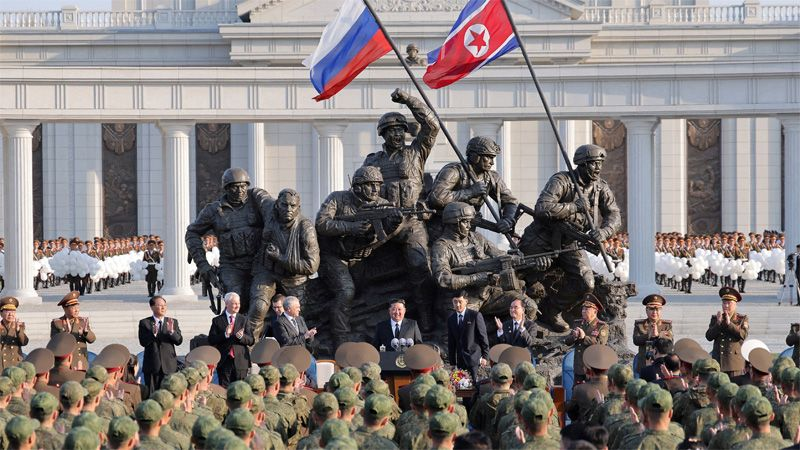
The North Korean troops deployed to support Russia in its war against Ukraine are gaining valuable battlefield experience as drones, robotics and other technologies continue to reshape realities of modern warfare.
The commander of the US Eighth Army has warned that lessons from a battlefield increasingly shaped by drones and robotics could have consequences for security in the Indo-Pacific.
“As we all are observing and watching how war is changing in Ukraine and in the Middle East, the North Koreans are, absolutely, doing that too,” Lt Gen Joseph Hilbert told reporters in Washington this month, according to Axios.
“I won’t get into the specifics of what the relationship looks like between Russia and the DPRK,” he added. “But there’s obvious cooperation there.”
South Korean intelligence estimates that North Korea has sent more than 16,000 personnel to Russia since October 2024, while Ukrainian President Volodymyr Zelensky has warned that tens of thousands more could be deployed. The US Eighth Army is headquartered at Camp Humphreys, south of Seoul.
North Korean forces began deploying to Russia after Pyongyang and Moscow signed a partnership agreement in June 2024. Although the full terms of their military co-operation remain unclear, the arrangement offers North Korea opportunities to gain combat experience, generate revenue through weapons exports, test its military equipment and potentially acquire advanced Russian technology.The deployment marks a rare opportunity for North Korean troops and commanders to learn from sustained combat, as the country’s military has not participated in a major war since the Korean War ended in 1953. North Korean forces have been involved in operations in Russia’s Kursk region, where their experience could inform future military planning.
The benefits extend beyond battlefield training. North Korea has supplied Russia with large quantities of ammunition, artillery systems, rocket launchers and short-range ballistic missiles. The Centre for Strategic and International Studies estimates that Pyongyang has exported 15 million artillery shells to Russia since 2022.
Ukrainian intelligence has previously said North Korean factories accounted for as much as 40% of Russian artillery consumption at certain points in the war.
A report by The Korea Times, citing South Korean defence intelligence, said North Korea had sent around 33,000 shipping containers containing munitions and military equipment to Russia.
The arrangement also gives Pyongyang an opportunity to assess how its weapons perform under combat conditions. Such feedback can help improve accuracy, reliability and manufacturing quality.
A report in early 2025 indicated that North Korean ballistic missiles had become more accurate since the deployment began, although the extent of any battlefield-driven improvements remains difficult to establish independently.
Russia has also reportedly pledged assistance with drone and counter-drone technology in exchange for North Korean support, according to Japan’s public broadcaster NHK.
The financial returns are another significant benefit for Pyongyang. Reports have suggested Russia has paid up to $13 billion for North Korean military assistance, while Bloomberg estimated in August that the broader financial gains from sanctions evasion could reach $22 billion.
Of particular concern to Western governments is the possibility of Russian technology transfers. Potential areas include satellite systems, space-launch capabilities, precision-strike technology and air defence – fields in which North Korea has faced significant technical challenges under international sanctions.
Before the two countries signed their partnership agreement in June 2024, North Korean leader Kim Jong Un visited a Russian space launch facility in the country’s Far East.
US officials subsequently warned that Moscow could provide satellite and space-launch technology in return for North Korean ammunition and manpower. South Korean officials have also said Russia transferred air-defence missile systems to North Korea.
There is no publicly established evidence that Russia has directly assisted North Korea’s nuclear weapons programme. However, improvements in related technologies could indirectly benefit Pyongyang’s weapons research and development.
North Korea’s submarine programme has also drawn attention. In late 2025, Kim unveiled the hull of what was described as the country’s first nuclear-powered submarine. Russian assistance has been suggested as a possible factor in its development, although the extent of any such support has not been confirmed.
The longer-term concern for South Korea and the US is that North Korea could emerge from the conflict with better-trained personnel, more effective weapons and access to technologies that would otherwise be difficult to obtain.
The precise scale of those gains remains uncertain, but the military partnership has created opportunities for Pyongyang to strengthen capabilities that could have implications well beyond the Ukraine war.