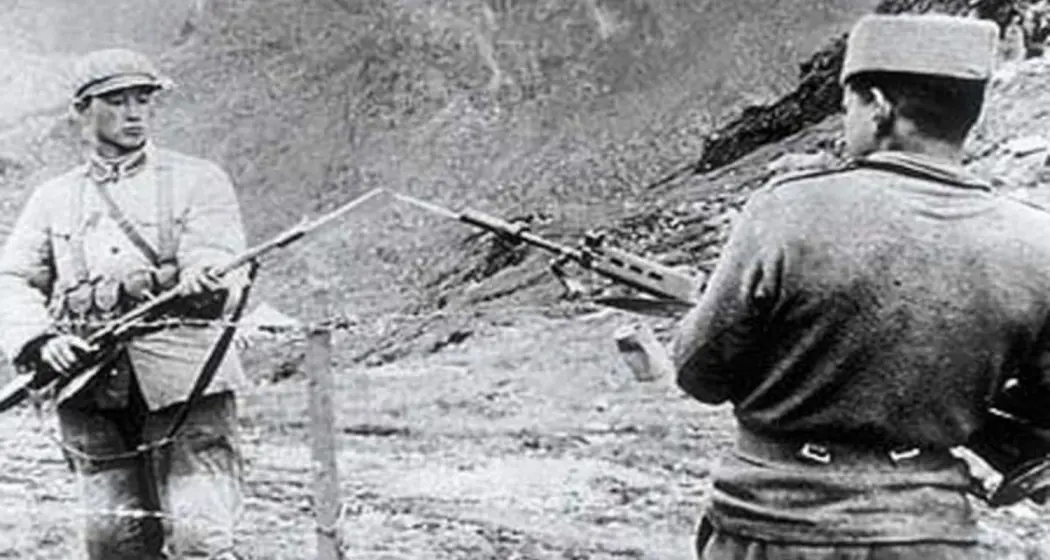
The clashes at Nathu La and Cho La in 1967 marked a decisive moment in India’s military history. Five years after the traumatic defeat of 1962, Indian troops confronted Chinese forces in the high Himalayas and, unlike in the earlier conflict, held their positions under intense pressure.
The significance of 1967 extended beyond the battles themselves. The confrontations demonstrated how far the Indian military had changed in the five years since 1962, as reforms in mountain warfare, logistics, communications and artillery began to translate into battlefield confidence.
The 1962 war had exposed serious weaknesses in India’s military preparedness. Troops operating in difficult mountainous terrain faced equipment shortages, inadequate communications and difficult logistical conditions. Forward positions came under severe pressure, and the eventual withdrawal left a deep psychological impact on the country.
India responded with a substantial effort to strengthen its armed forces. Mountain formations were reorganised and expanded, artillery received greater emphasis and the military began adapting more deliberately to the demands of high-altitude warfare.
By 1967, the force confronting China at Nathu La was markedly different from the one that had fought five years earlier.
Nathu La, located at more than 14,000 feet in what was then the Indian protectorate of Sikkim, occupied an important position along the frontier with Tibet. Its strategic location made it a natural point of confrontation.
Tensions escalated in August 1967 when Indian troops began erecting barbed wire to mark the boundary they regarded as the established frontier. Chinese troops objected, and confrontations became increasingly physical, with pushing, stone-throwing and heated exchanges reported in the weeks that followed.
On September 11, the confrontation turned into open violence.
Chinese troops opened machine-gun fire, wounding Lieutenant Colonel Rai Singh. The response from Indian troops was fundamentally different from the experience of 1962. They did not abandon their positions.
Indian artillery was brought into action under Major General Sagat Singh. Guns engaged Chinese positions and bunkers across the mountainous terrain, providing Indian troops with the firepower needed to hold their ground.
The importance of the episode lay not simply in the exchange of fire. It demonstrated that India had developed a greater capacity to combine defensive positions, artillery and battlefield planning in difficult Himalayan conditions.
The transformation was as much psychological as military.
The memory of 1962 had been one of vulnerability and retreat. Nathu La presented a different picture: troops prepared to remain in position despite pressure and commanders willing to use available firepower to defend strategically important ground.
The confrontation at Cho La weeks later reinforced that message.
On October 1, another clash broke out at Cho La. Indian troops again stood their ground. The bravery of soldiers including Subedar Waryam Singh, Havildar Narinder Singh, Havildar Tinjong Lama and Rifleman Gagan Chand was subsequently recognised.
Together, Nathu La and Cho La demonstrated a change in India’s military posture.
The clashes were not simply an attempt to reverse the humiliation of 1962. Their deeper significance was that India had begun rebuilding the capabilities and confidence necessary to defend its frontiers under pressure.
The lessons of 1962 had influenced reforms in training, logistics, communications and artillery. By 1967, those changes were being tested in an actual confrontation with China.
That mattered beyond the battlefield.
The clashes strengthened India’s confidence in its ability to defend strategically important territory and signalled that the country would not automatically yield ground when confronted by Chinese forces.
In the broader Asian strategic environment, Nathu La reinforced India’s credibility as a power capable of defending its interests along its Himalayan frontier. It also became an important reference point in the evolution of India’s military relationship with China.
The soldiers who fought at Nathu La and Cho La left a legacy that extends beyond the official records of their gallantry.
Their significance lies in what their stand represented at a pivotal moment in India’s post-1962 military development. The country had experienced defeat, studied its weaknesses and begun rebuilding. In 1967, those reforms were put to the test.
Nathu La therefore became more than a border clash. It became a marker of India’s transition from the shock of 1962 towards a more confident and prepared military posture.
The guns that echoed across the Himalayan heights in September and October 1967 eventually fell silent. The strategic lesson endured: credible deterrence depends not on seeking conflict, but on possessing the preparedness, resolve and capability to withstand pressure when a frontier is challenged.