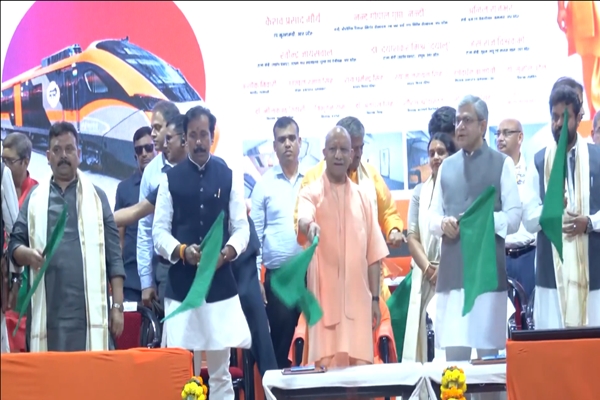
Railway Minister Ashwini Vaishnaw said that Prime Minister Narendra Modi has approved the Northern Corridor of the bullet train network. He said that the Northern Corridor will start from Delhi and connect Agra, Kanpur, Lucknow and Ayodhya, before extending further to Varanasi, Patna and eventually Guwahati. While addressing the flagging off ceremony of the new Vande Bharat Sleeper Express between Varanasi and New Delhi from Banaras Railway Station, Union Minister said that once this Northern Corridor is completed in the coming years, the journey from Delhi to Lucknow will take just 2 hours and 12 minutes, while Delhi to Varanasi will take 3 hours and 33 minutes.
Railway Minister Ashwini Vaishnaw and Uttar Pradesh Chief Minister Yogi Adityanath jointly flagged off the new Vande Bharat Sleeper Express between Varanasi and New Delhi. They also flagged off two new MEMU train services connecting Varanasi to enhance rail connectivity in the region. The Union Minister said that the Vande Bharat Sleeper train will prove to be an excellent transportation facility for middle-class families. He added that the train has been built using advanced, state-of-the-art technology with a primary focus on the comfort of both passengers and the crew, including the loco pilots.
Speaking on the occasion CM Yogi Adityanath said that India has witnessed rapid infrastructure growth under the leadership of Prime Minister Narendra Modi. He added that these new rail services will significantly strengthen the connectivity in the Purvanchal region.
The fully air-conditioned, 16-coach New Delhi-Varanasi Vande Bharat sleeper train has a passenger capacity of 823, with one First AC, four AC 2-Tier and 11 AC 3-Tier coaches. The two new MEMU trains connect Varanasi City Railway Station with Rajatalab and Prayagraj Rambagh with Varanasi.
Earlier, Railway Minister inspected the redevelopment work of Kashi Railway Station and the under-construction Namo Setu in Varanasi today. He also reviewed the progress of the projects with railway officials.
After inspection, the Railway Minister said that Namo Setu will be a combined railway and road bridge. He added that Namo Setu is being constructed keeping in mind the transportation needs of the next 100 years. The bridge will have a six-lane highway on the upper deck and four railway tracks on the lower deck.