By Ravish Handoo
Pakistan’s decision to impose Governor’s Rule in Khyber Pakhtunkhwa has reopened an enduring question about the country’s political system: can an elected government survive when its mandate collides with the interests of the powerful establishment?
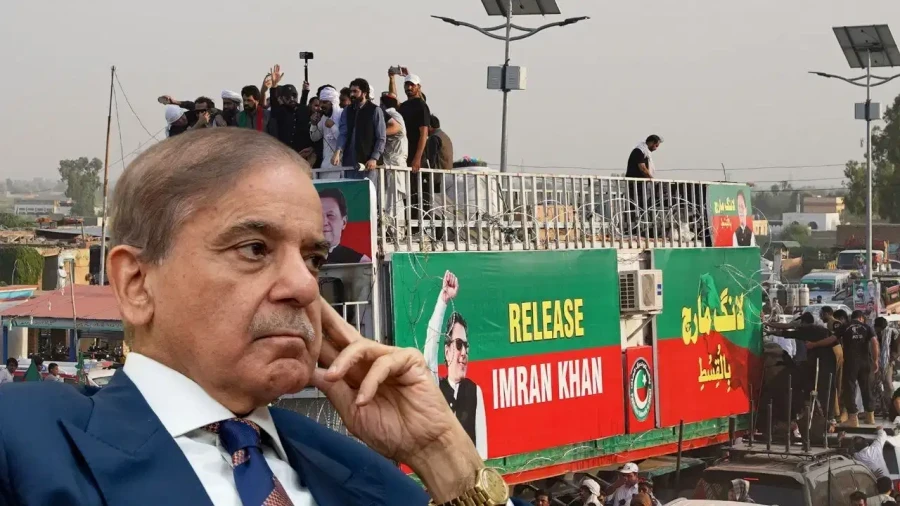
The confrontation between Islamabad’s ruling coalition and the Pakistan Tehreek-e-Insaf (PTI), led by jailed former prime minister Imran Khan, is no longer simply a contest between rival political parties. It reflects a deeper struggle over constitutional authority, provincial autonomy and the role of the military in determining Pakistan’s political direction.
The federal government has defended its intervention on security grounds, citing the challenge posed by militancy. Yet the circumstances surrounding the decision, as described in the supplied material, raise questions about whether counterterrorism has also become a justification for consolidating political control.
The distinction matters. A government has both the authority and the responsibility to confront terrorism. But security concerns cannot, by themselves, settle the question of whether an elected provincial administration should be displaced. That requires a clear constitutional basis, credible evidence and meaningful institutional scrutiny.
When the Ballot Clashes with the Establishment
Khyber Pakhtunkhwa has remained a major political stronghold of Imran Khan’s PTI. The party’s continued electoral presence has made the province an important centre of opposition to the federal government.
The February 2024 general elections intensified Pakistan’s political divisions, with allegations of electoral manipulation and disputes over the legitimacy of the resulting government. The PTI and its supporters have continued to challenge the political order that emerged from those elections.
The imposition of Governor’s Rule must therefore be viewed against this wider background of political confrontation.
According to the supplied account, Chief Minister Sohail Afridi and his cabinet were removed from office, with the province placed under Governor Faisal Karim Kundi and a technocratic administrative arrangement. The federal government presented the intervention as necessary to address the security situation.
The opposition, however, questioned the necessity and legality of the move, arguing that the security crisis was being used to weaken a government elected under the PTI banner.
These competing claims require examination through constitutional procedures and verifiable evidence. Nevertheless, the political consequences are unmistakable: when an elected provincial administration is removed through extraordinary measures, the legitimacy of the intervention becomes as important as the justification offered for it.
The central question is not whether the PTI should be immune from scrutiny. No political party should enjoy such immunity. It is whether the same constitutional standards are being applied consistently, regardless of which party governs a province.
Democracy cannot be reduced to the holding of elections alone. It also requires that electoral outcomes be respected within the constitutional framework and that disputes be resolved through established institutions rather than through the selective application of exceptional powers.
The Security Argument and Its Constitutional Limits
Khyber Pakhtunkhwa faces a serious challenge from militant violence. The province’s geography, its proximity to Afghanistan and the continuing activity of armed groups have made security a persistent concern for successive Pakistani governments.
The state cannot ignore this threat. Protecting citizens, preventing militant attacks and maintaining public order are legitimate responsibilities of the government.
But the existence of a security crisis does not automatically establish that an elected provincial administration must be suspended.
The federal authorities have levelled allegations against the PTI provincial leadership, including claims of links with the Tehreek-e-Taliban Pakistan. Such accusations are serious and require evidence. If substantiated, they must be addressed through lawful investigation and prosecution. If they cannot be substantiated, they should not become the basis for dismantling an elected government.
The supplied material records objections from opposition representatives over the evidence presented to justify the intervention. It also describes questions about the invocation of Articles 232 and 234 of Pakistan’s Constitution.
These constitutional provisions concern extraordinary circumstances, but their use must remain subject to the legal requirements governing them. The precise justification for invoking them, the scope of the powers exercised and the mechanisms available for judicial scrutiny are therefore central to determining whether the intervention is constitutionally sustainable.
The danger arises when the language of national security becomes so broad that it can be used to justify almost any political action.
Security operations may disrupt militant networks, but lasting stability also requires public confidence in the state. If citizens begin to view counterterrorism measures as instruments for settling political scores, cooperation with state institutions can become more difficult to sustain.
The government’s responsibility is consequently twofold: to demonstrate that its security measures address a genuine threat and to establish that those measures remain within constitutional limits.
Pakistan’s Enduring Civil-Military Imbalance
Pakistan’s political history has repeatedly demonstrated the difficulties faced by civilian institutions in establishing authority independent of the military establishment.
The country has experienced periods of direct military rule, the dismissal of elected governments and recurring confrontations between civilian leaders and the security establishment. Even under formally civilian administrations, questions about the military’s influence over political decision-making have remained central to public debate.
The present confrontation in Khyber Pakhtunkhwa has revived these questions.
The supplied material places the intervention within a wider struggle involving the federal coalition, Imran Khan’s political movement and the military leadership under Field Marshal Asim Munir. It argues that the removal of the PTI government reflects the establishment’s determination to reduce the party’s political influence.
That interpretation should be distinguished from what can be conclusively established about the decision-making process. Nevertheless, the broader institutional question is legitimate: who exercises decisive authority when political competition intersects with national security?
Civilian governments cannot claim full political responsibility while operating within an arrangement in which important decisions may be shaped by institutions that are not directly accountable to voters. Equally, military institutions cannot remain insulated from scrutiny when their actions have consequences for civilian government and constitutional rights.
This imbalance creates a recurring cycle. Political parties seek the support of powerful institutions when it serves their interests, only to discover that such support can become a source of dependence. Governments change, alliances shift and political rivals exchange positions, but the underlying contest over institutional authority remains unresolved.
Pakistan’s political stability depends in part on whether its civilian institutions can establish a durable framework in which the military performs its constitutional responsibilities without becoming the ultimate arbiter of political competition.
Removing one provincial administration does not settle that question. It risks postponing it once again.
Governor’s Rule and the Future of Federalism
The controversy also raises serious questions about provincial autonomy.
A federation rests on the understanding that authority is divided constitutionally between the central government and its constituent units. Provincial governments are not merely administrative extensions of the federal capital. They possess their own democratic mandates and responsibilities.
Extraordinary constitutional provisions may be necessary when a province cannot be governed through normal arrangements. But the exercise of such powers must be justified by the circumstances and limited by the Constitution.
If Governor’s Rule becomes an instrument for removing governments because they belong to opposition parties, the principle of federalism is weakened. Provincial autonomy then becomes conditional on political alignment with the centre rather than a constitutional guarantee.
The consequences extend beyond the party currently in power in a province. Once the precedent is established that an unfavourable political outcome can be reversed through extraordinary intervention, future governments may find it easier to justify similar measures against their opponents.
Pakistan’s history contains earlier instances of Governor’s Rule and the dismissal of provincial governments. The recurrence of such interventions suggests that the underlying tension between central authority and provincial representation has never been fully resolved.
The question is whether the present crisis will deepen that pattern or prompt a more serious examination of the safeguards needed to protect elected provincial institutions.
A federation cannot function effectively if its constituent units have reason to believe that their political autonomy will be respected only when their electoral choices are acceptable to the ruling coalition.
The Cost of Political Repression
The supplied account also describes allegations of arrests, forced disappearances, restrictions on communications and the use of force against political demonstrators following the imposition of emergency measures.
Such allegations require independent investigation. They should neither be accepted uncritically nor dismissed without examination.
The treatment of political opponents is an important measure of a state’s commitment to the rule of law. Arrests must have a lawful basis, detainees must receive due process, and allegations of excessive force must be investigated by competent and independent authorities.
The same standards must apply to elected representatives, political activists and ordinary citizens.
If people are detained unlawfully or prevented from exercising fundamental rights, the state risks transforming a political dispute into a wider crisis of public confidence. Restrictions imposed in the name of order may suppress visible opposition temporarily, but they do not necessarily resolve the grievances that produced it.
The government must also recognise that peaceful political mobilisation is not equivalent to militancy. Genuine criminal conduct must be addressed through the law, but political disagreement cannot itself become grounds for treating citizens as security threats.
For the PTI, the responsibility is equally clear: political opposition must remain within constitutional and peaceful channels. No party can claim democratic legitimacy while disregarding the legal obligations that apply to all political actors.
The test of Pakistan’s institutions is whether they can enforce the law impartially, rather than according to political allegiance.
The Two-Month Promise and the Question of Accountability
The federal government’s stated intention to review the situation after two months, as reported in the supplied material, raises a further question: what criteria will determine whether Governor’s Rule should continue?
A review period is meaningful only if it is tied to measurable objectives, transparent findings and a clear legal process. Without such safeguards, an announced review risks becoming a procedural formality rather than a genuine assessment of necessity.
The government should explain what improvements it expects in security, what evidence will be used to evaluate those improvements and which institutions will assess whether extraordinary measures remain justified.
It must also clarify how the rights of elected representatives and ordinary citizens will be protected during the period of federal intervention.
The public should not be asked to accept an open-ended suspension of normal political arrangements on the basis of assurances alone. Nor should a security crisis become an excuse to postpone accountability for failures by either civilian or military authorities.
If the intervention is necessary, the government should be able to defend it through evidence and constitutional reasoning. If its necessity diminishes, the restoration of normal governance should follow the applicable constitutional process without political obstruction.
Accountability cannot be replaced by promises that the situation will improve eventually.
A Crisis Larger Than One Political Party
The fate of Khyber Pakhtunkhwa’s provincial government is inseparable from the larger struggle over Pakistan’s political institutions. Yet the issue should not be reduced to a contest between supporters and opponents of Imran Khan.
The PTI is entitled to due process and the protection of its constitutional rights, just as its political rivals are. Its leaders must answer any substantiated allegations through lawful procedures. The federal government, in turn, must demonstrate that its actions are constitutionally justified and not merely politically expedient.
The same principle applies to the military establishment. National security is an essential state responsibility, but it does not place any institution beyond legal or public accountability.
Pakistan’s political system will remain vulnerable to recurring crises if elections are treated as temporary arrangements, provincial autonomy as a negotiable privilege and constitutional safeguards as instruments to be invoked selectively.
The immediate challenge is to establish a credible legal basis for the measures imposed in Khyber Pakhtunkhwa, ensure due process for those detained and preserve the ability of political parties to operate peacefully. The longer-term challenge is to build institutions capable of resolving political disagreements without resorting repeatedly to extraordinary powers.
The removal of a government may change who occupies the provincial administration. It cannot, by itself, eliminate the political movement that brought that government to power or resolve the disputes that divide the country.
Pakistan now faces a test of whether its institutions can place constitutional limits above short-term political advantage.
A provincial mandate is not an unconditional licence to govern. Nor is it an obstacle that the centre may remove whenever political circumstances become inconvenient. It is an expression of electoral choice that must be handled within the framework of the law.
When the relationship between the ballot, the Constitution and the exercise of power becomes uncertain, the damage extends beyond a single administration. It reaches the foundations of federal government itself.
Pakistan’s path out of this crisis will depend not on which political faction prevails, but on whether the country’s institutions can establish rules that apply equally to those who govern, those who oppose them and those who wield power beyond the ballot box.