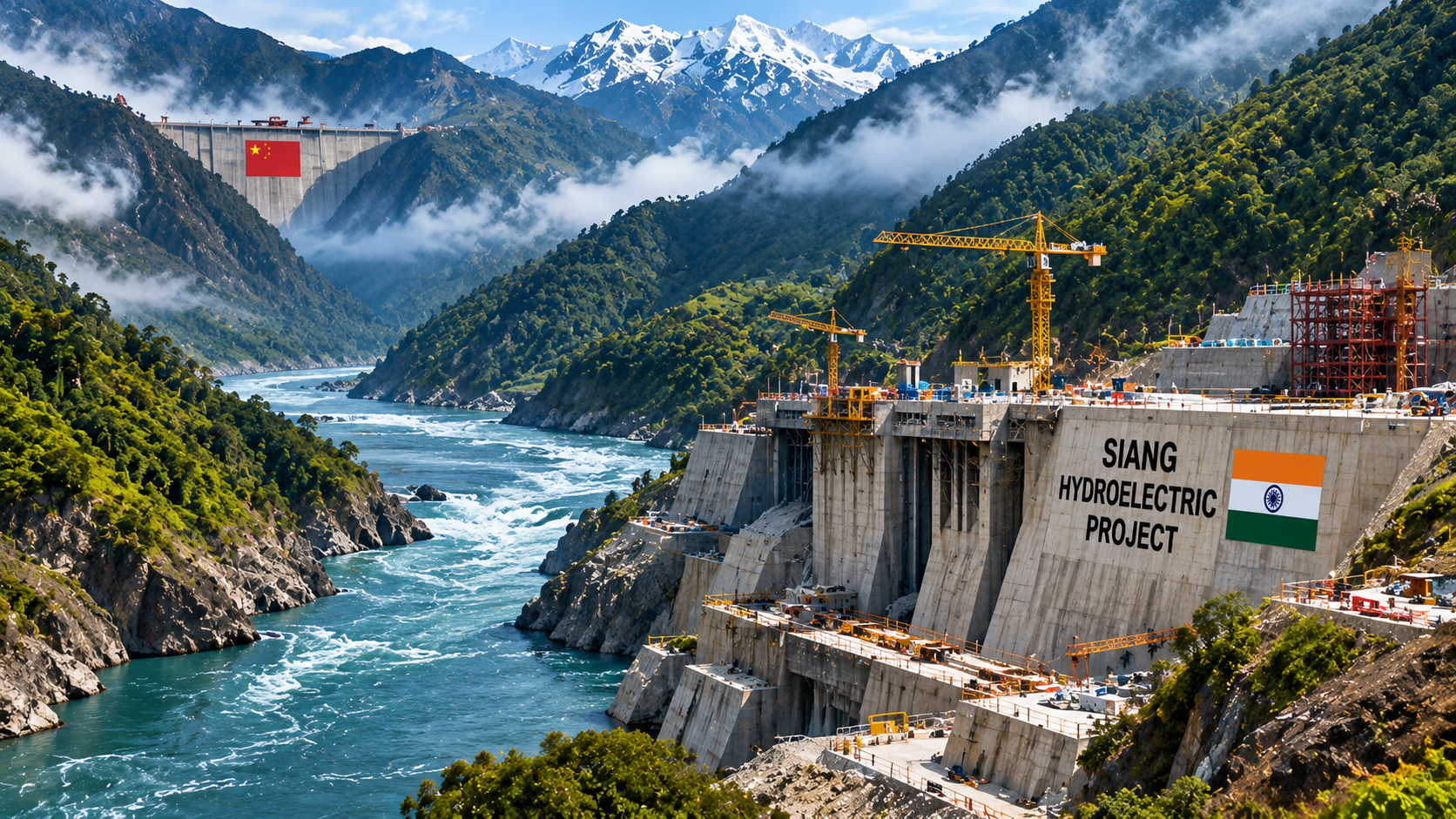
China’s construction of a massive hydropower complex on the Yarlung Tsangpo in Tibet has added a new dimension to India’s security calculations in the eastern Himalayas. The project is not simply an energy undertaking. Its location on a major transboundary river gives it implications for downstream water management, regional stability and India’s long-term strategic interests. Against this backdrop, the proposed Siang Upper Multipurpose Project in Arunachal Pradesh must be viewed as an important component of India’s broader approach to water security.
The Brahmaputra, known as the Yarlung Tsangpo in Tibet, originates in the Tibetan Plateau and flows eastwards before making a dramatic turn south through the Himalayas. It enters Arunachal Pradesh as the Siang, travels through Assam and eventually flows into Bangladesh. This geographical reality gives China an upstream position over a river system that supports communities, agriculture, infrastructure and economic activity across several downstream regions.
Beijing began construction of its major hydropower project on the lower reaches of the Yarlung Tsangpo in July 2025. With a reported planned capacity of approximately 60,000 megawatts and an estimated investment of 1.2 trillion yuan, the development is expected to become one of the world’s largest hydropower complexes. Its scale and location have understandably attracted attention in New Delhi.
The concern is not limited to the possibility of water diversion. Large upstream infrastructure can influence the timing and management of river flows, depending on reservoir capacity, operating procedures and seasonal conditions. Sudden releases, changes in storage patterns or interruptions to hydrological data sharing could complicate flood forecasting and downstream water management. The actual effects will depend on the project’s final design and operational practices, but India cannot afford to approach these uncertainties without adequate preparedness.
For a downstream country, access to reliable information about upstream river infrastructure is essential. Hydrological data, advance notification of unusual water releases and transparent operating arrangements are necessary for effective flood management. India’s concerns therefore extend beyond the construction of a dam to the broader question of whether Beijing will provide sufficient information and maintain meaningful cooperation on a shared river system.
This is where the proposed Siang Upper Multipurpose Project assumes strategic importance.
Planned in Arunachal Pradesh with an installed capacity of approximately 11,200 megawatts, the project is envisaged as more than a conventional hydropower facility. Its proposed reservoir is intended to provide substantial water storage and help regulate flows in the Siang basin. Arunachal Pradesh Deputy Chief Minister Chowna Mein has cited an estimated live storage capacity of around 9.2 billion cubic metres.
Such storage could give India additional flexibility in managing seasonal variations and responding to certain upstream flow fluctuations. It could also strengthen flood-management capabilities in the Siang basin and downstream areas of Assam, subject to the reservoir’s final design, available storage and operating rules.
The strategic significance lies in creating domestic capacity to manage a river system whose upstream reaches are increasingly influenced by infrastructure decisions made outside Indian territory. India cannot determine how China operates its dams in Tibet. It can, however, improve its own monitoring, storage, forecasting and disaster-response capabilities.
The comparison between the Chinese and Indian projects should not be reduced to installed power capacity. China’s reported 60,000-MW project and India’s proposed 11,200-MW Siang project have different geographical settings and stated objectives. The latter’s strategic value is closely connected to water storage and flow regulation, alongside electricity generation. Its effectiveness must therefore be assessed through its hydrological and operational capabilities rather than simply through the amount of power it could produce.
For India, the Siang project also fits into a wider requirement to strengthen infrastructure in the eastern Himalayan region. Arunachal Pradesh occupies a strategically important position along India’s border with China. Reliable electricity, improved connectivity, communications infrastructure and stronger disaster-management systems are essential to the region’s long-term development and national security.
Hydropower development can contribute to this effort by supporting electricity availability in the Northeast and strengthening the regional energy network. An 11,200-MW project, if found technically and economically viable, could add substantial generating capacity. It could also support associated infrastructure and economic activity. These benefits, however, must be evaluated against the project’s financial, environmental, geological and engineering requirements.
The location of the proposed project makes scientific assessment particularly important. The eastern Himalayas are seismically active, and any large reservoir must be evaluated for geological stability, seismic exposure and downstream consequences. The project must also be designed around the hydrological characteristics of the Siang basin. Strategic urgency cannot substitute for engineering evidence. A project intended to strengthen national security must itself meet the highest standards of safety and reliability.
The current feasibility process is therefore a critical stage. The proposed project has not received final approval for construction. Its preliminary feasibility assessment must establish whether the planned storage, power generation and flow-management objectives can be achieved under actual geographical and hydrological conditions. A final decision should be based on comprehensive technical studies and the results of the required environmental and statutory assessments.
At the same time, India must avoid placing all its confidence in a single infrastructure project. The Siang reservoir, even if developed, would form only one part of a much broader water-security framework. Continuous river monitoring, improved forecasting systems, satellite-based observation and coordination between central and state agencies will remain essential.
Diplomatic engagement with China is equally important. India has already raised concerns over the potential downstream impact of Chinese projects through established bilateral mechanisms, including the Expert Level Mechanism on transboundary rivers. Such engagement should seek greater transparency, timely hydrological information and advance communication regarding changes in river operations.
The challenge is that water cooperation takes place within a wider strategic relationship marked by unresolved border issues and competing interests. This makes institutional mechanisms and verifiable information particularly important. Neither country benefits from uncertainty over a river system that affects millions of people downstream. Yet India must prepare for situations in which diplomatic assurances alone may not provide sufficient protection.
The wider Brahmaputra basin also gives India an important regional responsibility. The river continues from Assam into Bangladesh, making downstream water management a matter of broader regional significance. Better forecasting, disaster preparedness and information-sharing arrangements can strengthen cooperation with Bangladesh and improve resilience across the basin.
China’s upstream hydropower expansion has changed the strategic context in which India must manage the Brahmaputra. The response requires a combination of infrastructure, technology, diplomacy and long-term planning. The Siang Upper Multipurpose Project could become an important part of that response, provided its proposed capabilities are established through rigorous assessment.
India’s objective should not be to mirror China’s construction ambitions or enter a contest measured only in megawatts. It should be to ensure that developments upstream do not leave downstream regions vulnerable to uncertainty. Water storage, dependable hydrological information, flood preparedness and resilient infrastructure must form the foundation of that strategy.
The Brahmaputra is not merely a river crossing an international boundary. It is a strategic resource whose management has implications for national security, economic development and regional stability. As China expands its infrastructure on the Yarlung Tsangpo, India must strengthen its ability to understand, manage and protect its interests along the river system.
The Siang project represents an important opportunity in that effort. Its ultimate value will depend on whether it can deliver the promised water-management and energy benefits safely and sustainably. For India, the larger principle is clear: control over its own preparedness and resilience must not depend on decisions taken upstream.