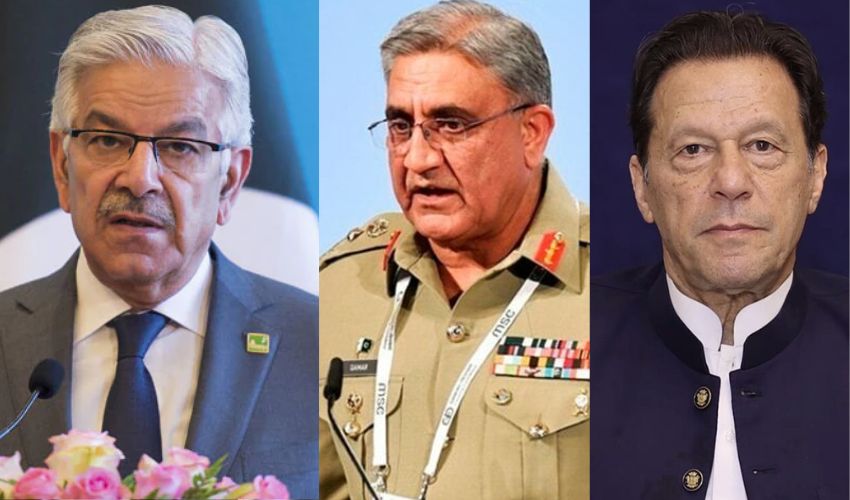
In a bold statement to the media in Islamabad, Pakistan’s Defense Minister Khawaja Asif has leveled serious accusations against former Army Chief General Qamar Javed Bajwa, former ISI chief Faiz Hameed, and PTI founder Imran Khan, accusing them of facilitating the return and resettlement of terrorists in Pakistan. Asif described this as a “compromise of mutual interests,” suggesting a deeply troubling collaboration among these figures that threatens the country’s security.
The minister also called for questioning General Bajwa, just as Faiz Hameed has been arrested, claiming that both men should be held accountable for their roles in these alleged actions. Asif emphasized that the fight against terrorism is a collective effort and that Pakistan’s role in addressing terrorism is critical, even as he criticized the Khyber Pakhtunkhwa government for its “zero role” in combating the issue.
Asif pointed to recent successes, such as Pakistan’s fulfillment of its international responsibilities, including the arrest of a terrorist and his subsequent handover to the United States. He commended Pakistan for its efforts, noting that international praise for these actions was a positive development for the nation.
Revelations on General Bajwa’s Threat to Impose Martial Law
In addition to the terrorism-related allegations, Khawaja Asif revealed startling claims about General Qamar Javed Bajwa’s behavior during his tenure as Army Chief. According to Asif, Bajwa had sought an extension of his tenure, ranging from six months to a year, and even threatened to impose martial law if his demand was not met. Asif described these actions as attempts to coerce the government into granting him an extension, and stated that these demands were not made in private, but were openly expressed during official meetings.
The Defense Minister’s claims paint a picture of a military leader who was willing to go to extreme lengths, including threatening the stability of the country, to secure his position at the top. These new revelations have sparked a fresh wave of political discourse in Pakistan, with many questioning the true motives behind the former army chief’s actions.
As tensions rise over these revelations, it’s clear that the political and military landscape of Pakistan is set to undergo further scrutiny, with calls for accountability growing louder across the country.