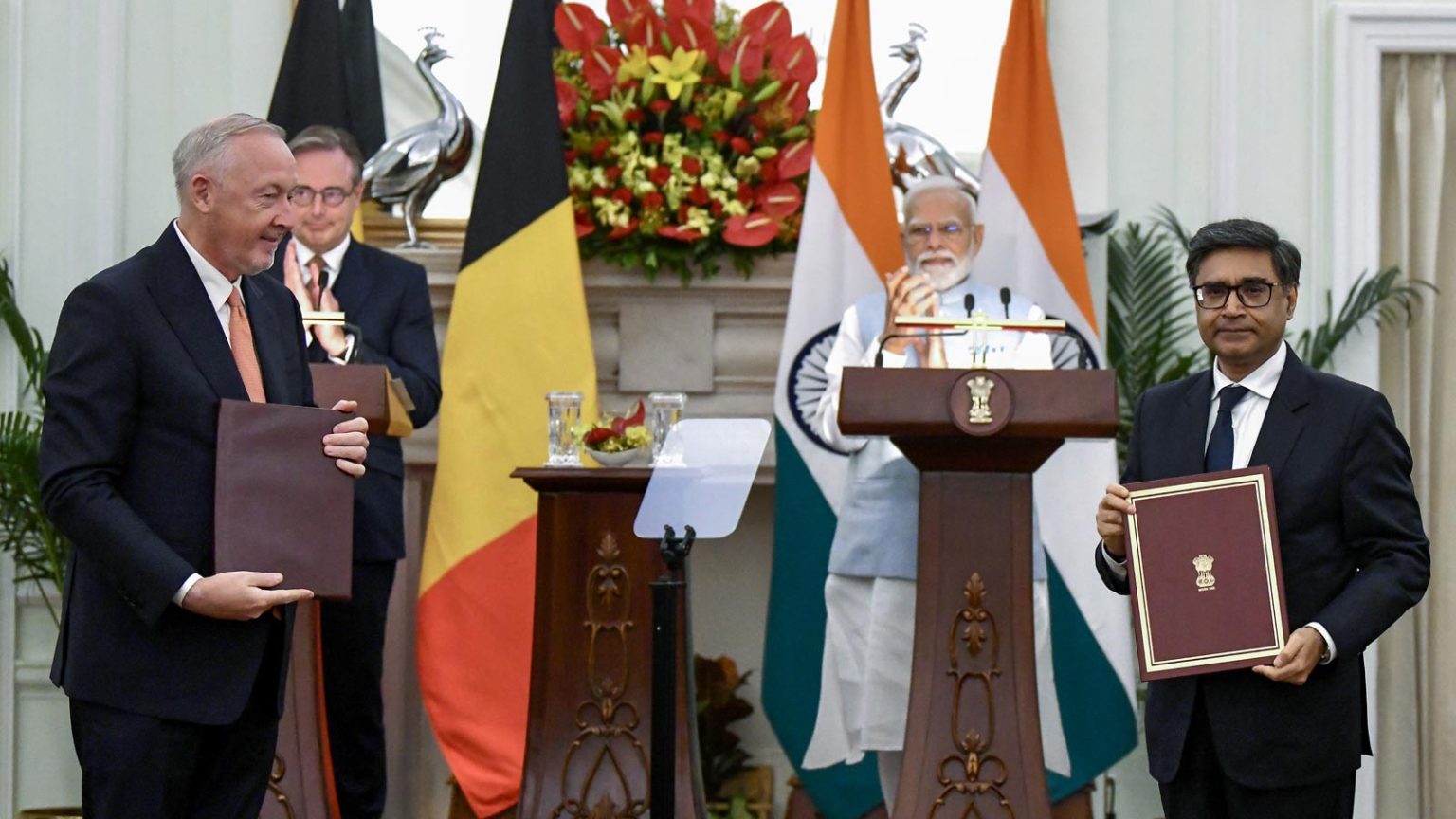
India and Belgium on Thursday agreed to further deepen their strategic partnership, with the two countries announcing a series of measures to expand cooperation in defence, trade, investment, semiconductors, renewable energy, critical minerals, maritime security and people-to-people ties.
The decisions were taken during Belgian Prime Minister Bart De Wever’s first official visit to India since assuming office in February 2025. De Wever, who is visiting India from September 2 to 4 at the invitation of Prime Minister Narendra Modi, held bilateral talks with him in New Delhi.
The two leaders expressed their desire to further expand the multifaceted relationship, which is rooted in shared democratic values, economic complementarities and strong people-to-people ties. They also recalled the sacrifice of more than 9,000 Indian soldiers in Flanders Fields during the First World War.
The leaders noted that the 80th anniversary of India-Belgium diplomatic relations in 2027 would provide an opportunity to celebrate and further strengthen bilateral ties.
Strategic dialogue and India-EU partnership
India and Belgium welcomed the launch of their inaugural Strategic Dialogue in Brussels in July 2026. The mechanism is aimed at advancing cooperation in trade and investment, green transition, technology, connectivity, defence, security and people-to-people relations.
The two sides also reaffirmed the importance of the India-EU Strategic Partnership and welcomed the successful conclusion of negotiations for the India-EU Free Trade Agreement in January 2026.
The leaders called for the early conclusion of negotiations on the India-EU Investment Protection Agreement and the Geographical Indications Agreement and stressed the timely implementation of the FTA to diversify critical value chains and open new markets.
They also welcomed progress under the India-EU Trade and Technology Council and endorsed the Joint India-EU Comprehensive Strategic Agenda for 2030.
Push to double bilateral trade
With Belgium and India seeking to expand economic engagement, the two Prime Ministers agreed to work towards doubling bilateral trade over the next five years.
The two countries welcomed the launch of an India-Belgium Investment Fast-Track Mechanism to facilitate investments in both directions, address business-related bottlenecks and create a more conducive environment for long-term economic cooperation.
India and Belgium also agreed to strengthen engagement between Belgium’s Federal Holding and Investment Company (SFPIM) and India’s National Investment and Infrastructure Fund (NIIF), with a view to establishing an Indo-Belgian economic and investment corridor.
The leaders highlighted opportunities for cooperation in life sciences, pharmaceuticals, healthcare, energy, renewable energy, defence, aerospace and space, logistics, ports, clean technology, advanced materials, manufacturing, digital technologies and innovation.
They also reaffirmed the importance of the historic diamond trade connecting Antwerp with Mumbai and Surat while exploring new areas of economic cooperation.
Defence and counter-terrorism cooperation
Defence and security emerged as a key pillar of the expanding partnership. The two sides welcomed the signing of a Letter of Intent between their defence ministries covering regular exchanges, staff talks, education and training, research cooperation and defence-industrial partnerships.
India and Belgium also expressed support for greater collaboration in defence manufacturing, technology, innovation, co-development and co-production.
Belgium reiterated its solidarity with India in the fight against terrorism, including cross-border terrorism, and condemned the April 2025 terrorist attack in Pahalgam, Jammu and Kashmir.
The two countries agreed to explore the establishment of a Belgium-India Joint Working Group on Counter-Terrorism to enhance cooperation against evolving terrorist threats, including terrorist financing, networks and safe havens.
They also welcomed a memorandum of understanding between India’s Central Bureau of Investigation and Belgium’s Federal Police to strengthen cooperation against transnational organised crime and cybercrime.
The two countries will enhance intelligence and information sharing, capacity building, tracing of fugitives and exchange of best practices.
Belgium will appoint a Defence Attaché in New Delhi, while India plans to appoint a resident Defence Attaché at its embassy in Brussels.
Renewable energy, green hydrogen and critical minerals
India and Belgium renewed their memorandum of understanding on renewable energy cooperation, expanding collaboration in green hydrogen, solar energy, energy storage, offshore wind, bio-energy, small hydropower and pumped storage projects.
The two sides also welcomed growing cooperation in green hydrogen, including industrial partnerships and knowledge exchange, and emphasised the importance of building resilient green hydrogen value chains.
The countries further agreed to enhance cooperation in critical minerals, particularly in processing and recycling, as part of efforts to strengthen reliable supply chains.
Semiconductor and technology cooperation
The two Prime Ministers encouraged closer engagement between Belgium’s semiconductor research ecosystem, including imec, and Indian institutions and companies.
The cooperation is aimed at developing advanced semiconductor technologies and building resilient technology ecosystems in both countries.
India and Belgium also welcomed collaboration in artificial intelligence, emerging technologies, start-ups and digital skills. Cooperation between the MeitY Startup Hub and Belgian startup ecosystem was encouraged to promote innovation-driven entrepreneurship and skills development.
Maritime and port cooperation
The two countries identified maritime and port cooperation as an important area for future collaboration, including port development, logistics, connectivity, dredging and offshore wind infrastructure.
They welcomed potential cooperation between the Antwerp/Flanders Port Training Centre and the Jawaharlal Nehru Port Authority, particularly in training and capacity building for India’s port and maritime sector.
Belgian dredging expertise was also recognised for its contribution to Indian port infrastructure and its potential role in offshore renewable energy projects.
Education, mobility and people-to-people ties
India and Belgium agreed to strengthen cooperation in higher education, research and scientific fields, including astronomy, astrophysics and space technologies.
PM Modi invited leading Belgian universities and academic institutions to explore opening campuses in India under the country’s National Education Policy.
The two sides also encouraged cooperation in skill development and technical and vocational education, including apprenticeships, industry-oriented training, emerging skills and recognition of qualifications.
To facilitate greater mobility of professionals, students, researchers and business travellers, the two countries agreed to work towards enhanced visa processing and direct air connectivity.
The leaders also welcomed cooperation in healthcare, including initiatives facilitating the mobility of qualified Indian nurses to Belgium, and agreed to continue discussions towards a Mobility and Migration Partnership Agreement.
Cooperation on global issues
The two Prime Ministers exchanged views on the conflicts in Ukraine and West Asia and reaffirmed their support for dialogue and diplomacy.
On Ukraine, both sides backed efforts towards a comprehensive, just and lasting peace in accordance with the UN Charter and international law. On West Asia, they stressed the importance of diplomatic engagement and peaceful resolution of challenges.
They also emphasised the need to ensure the safety of maritime routes and maintain safe and unimpeded international shipping.
India and Belgium reaffirmed their commitment to democracy, the rule of law, human rights, gender equality and a rules-based international order.
At the end of the visit, De Wever invited PM Modi to undertake a bilateral visit to Belgium at a mutually convenient time.