




Air travel across the United States was severely disrupted on Friday, November 13, after the Federal Aviation Administration (FAA) ordered a nationwide ground stop for departing flights. The decision, which remained in place for over four hours, was made due to a communication issue affecting all Air Route Traffic Control Centers across the country.
The disruption raised serious concerns about the ability of air traffic controllers to maintain normal communication and coordinate aircraft movements safely. As a precautionary measure, the FAA ordered a nationwide ground stop, temporarily preventing departing flights from taking off at airports across the country.
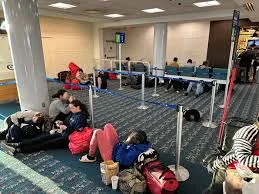
According to available reports, more than 6,000 flights were cancelled on Friday, while airlines had already cancelled nearly 1,400 additional flights scheduled for Saturday. More than 600 aircraft were also diverted to alternative airports during the disruption. Airports experienced crowded terminals, passengers waiting for updates, and airlines struggling to rearrange aircraft and crew schedules.
The impact extended beyond domestic travel, with international departures also facing restrictions and individual operational decisions. US Homeland Security Secretary Markwayne Mullin said there was no indication at the time that the incident involved a deliberate hostile attack. Officials initially pointed towards a telecommunications outage affecting critical aviation communication infrastructure.
However, authorities indicated that the investigation was continuing and that the precise cause needed further examination. The incident has renewed concerns about the technology supporting America's air traffic control infrastructure. Transportation Secretary Sean Duffy indicated that problems involving aging hardware and inconsistent server data contributed to the disruption.
The incident has intensified discussions about upgrading outdated systems, strengthening communication networks, and ensuring reliable backup infrastructure. For a country with one of the world's busiest aviation networks, even a temporary communication failure can create consequences across thousands of flights.
The FAA lifted the nationwide ground stop on Friday evening, allowing departures to resume under a controlled process. However, lifting the restriction did not immediately restore normal airline operations. Aircraft were positioned at unexpected airports, flight crews faced scheduling challenges, and passengers continued to experience delays and cancellations.
Travellers have been advised to check directly with their airlines before heading to airports and to confirm their revised departure times. The US aviation disruption highlights how heavily modern air travel depends on reliable communication and air traffic management infrastructure. A failure affecting critical communication networks can quickly spread across airports, airlines, and international travel routes.
The incident is likely to intensify calls for investment in modern aviation technology, stronger backup systems, and improved operational resilience. The biggest question now is what caused the communication failure and what steps the United States will take to prevent a similar disruption in the future. For millions of travellers, the immediate priority remains getting back to normal flight schedules.
Impact on Passengers and Airlines
The disruption has caused significant inconvenience to thousands of passengers, with many facing cancellations, delays, and unexpected travel disruptions. Airlines are working to restore normal schedules, but the process is expected to take time. The incident has also raised concerns about the long-term impact on the aviation industry, with potential consequences for airline operations, passenger confidence, and the overall economy.
Investigation and Response
The investigation into the cause of the communication failure is ongoing, with authorities working to determine the root cause of the disruption. The FAA and other relevant agencies are expected to provide updates on the investigation and any measures being taken to prevent similar incidents in the future. The incident has highlighted the need for robust communication systems and backup infrastructure to ensure the safe and efficient operation of air traffic control.
Global Implications
The US aviation disruption has significant implications for global aviation, highlighting the importance of reliable communication and air traffic management infrastructure. The incident is likely to prompt a review of aviation systems and protocols worldwide, with a focus on improving operational resilience and preventing similar disruptions in the future. As the investigation continues, the global aviation community will be watching closely to see what measures are taken to address the issues raised by this incident.