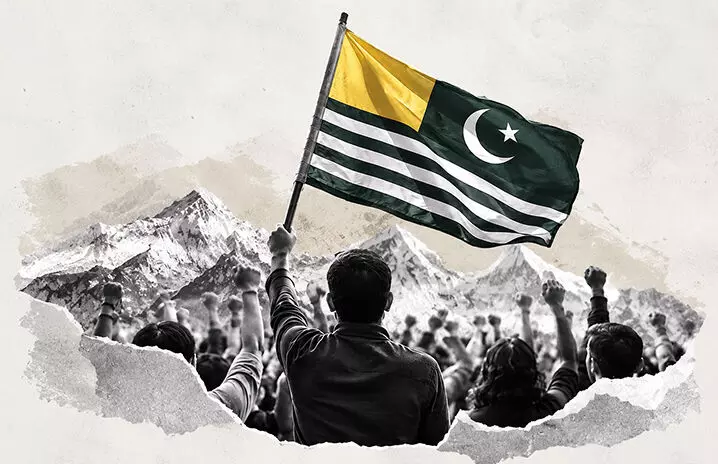
Months of protests, deadly clashes and restrictions across Pakistan-occupied Jammu and Kashmir have exposed a widening dispute over political representation, economic rights and the relationship between the territory’s residents and the governing structures tied to Islamabad.
At the centre of the confrontation is the Jammu Kashmir Joint Awami Action Committee, or JAAC, a broad civil society coalition whose campaign initially focused on electricity tariffs, subsidised wheat and public services but has expanded into demands concerning governance, accountability and political representation. Its most contentious demand is the abolition of 12 Legislative Assembly constituencies reserved for refugees from Jammu and Kashmir who live elsewhere in Pakistan.
The dispute turned violent in June after negotiations between the authorities and JAAC failed and the regional government proscribed the organisation under anti-terrorism legislation on June 5.
The ban was followed by communications restrictions, arrests and an increased security presence. Protesters responded with strikes, demonstrations and attempts to march on Muzaffarabad. Rawalakot, in Poonch division, emerged as the principal centre of the confrontation.
By June 19, at least 24 people had been killed in nearly two weeks of unrest, including 20 civilians and four police officers, according to Reuters. More than 500 people had been detained and dozens injured, including 97 police officers. Businesses closed, roads were disrupted and communications restrictions affected large parts of the territory.
Accounts of individual clashes have differed sharply.
Authorities accused armed elements among the protesters of firing on security personnel and attacking the Combined Military Hospital in Rawalakot. JAAC and its supporters accused security forces of using excessive force against demonstrators. Claims circulated on social media of casualty figures far higher than those established by credible reporting, but those numbers could not be independently substantiated.
The distinction is important in an information environment shaped by internet restrictions and competing political narratives. The confirmed deaths and injuries were themselves sufficient to make the unrest one of the territory’s most serious episodes of political violence in recent years without relying on unverified figures.
The Human Rights Commission of Pakistan subsequently concluded that longstanding political and socioeconomic grievances, institutional distrust and governance shortcomings had contributed to the crisis. Its fact-finding assessment said a confrontational state response, including what it described as disproportionate force, had deepened polarisation and damaged public trust.
The dispute over the 12 refugee constituencies has given the protests a political dimension extending beyond complaints about electricity and food prices.
Of the 45 elected seats in the Legislative Assembly, 33 represent constituencies inside the territory. The remaining 12 are elected by refugees from Jammu and Kashmir living across Pakistan. Six represent refugees originating from Jammu and six those from the Kashmir Valley.
The arrangement predates the current unrest and was incorporated into the 1974 Interim Constitution. JAAC argues that the system allows constituencies outside the territory to exercise disproportionate influence over the composition of its government. Supporters of the arrangement contend that the seats preserve political representation for displaced Kashmiris.
That disagreement has proved difficult to bridge.
On June 7, the regional Supreme Court ruled that the seats were constitutionally protected and could not simply be abolished through executive action. Removing them would require a constitutional amendment. The ruling left one of JAAC’s principal demands outside the immediate authority of the government to concede.
The confrontation then became intertwined with the 2026 Legislative Assembly election.
Polling, initially planned for all 45 seats on July 27, was divided into phases as the security situation deteriorated. Mirpur division voted first. Muzaffarabad division and the 12 refugee constituencies followed on August 2, while voting in Poonch was scheduled for August 10.
Even that timetable proved difficult to maintain. Polling in seven Poonch constituencies was postponed because of the law-and-order situation. Voting in one Muzaffarabad constituency was separately delayed after heavy rain and landslides prevented election personnel and material from reaching polling stations.
The protests did not disappear with the election.
Open-source material posted through September shows continuing gatherings in Rawalakot, Bagh and other areas. Footage circulated online from Chitra Topi in South Bagh on September 9 showed women, men and children taking part in a procession associated with the JAAC protest call. Other footage showed large gatherings in Rawalakot. These videos establish the persistence and geographic spread of mobilisation, although individual clips cannot by themselves establish the political views of the wider population.
Reports reviewed from open sources on social media have documented this continuing phase of the unrest. One September post placed a procession at Chitra Topi in South Bagh during the September 9 strike. Another documented a large gathering in Rawalakot on September 10, while footage from Chhota Galla on September 15 showed a torch procession after the protest movement had passed the 100-day mark.
Earlier BhairavForce reporting also tracked protest caravans travelling towards Muzaffarabad during the July mobilisation. A July 14 post showed a large gathering of vehicles and protesters in Mirpur preparing to join the march towards the regional capital.
Taken together, the material points to a movement that has survived the banning of JAAC, arrests of its leadership, an election and months of communications and movement restrictions. It does not, however, establish that every participant shares the same political objective. The movement encompasses economic demands, complaints about governance, opposition to the refugee-seat system and broader arguments over political rights.
That complexity matters.
The immediate trigger for much of the recent confrontation has been the dispute over representation, but the political constituency behind the protests developed through earlier campaigns over electricity prices, subsidised flour and public services. JAAC’s charter eventually expanded to 38 demands covering economic relief, infrastructure, accountability and constitutional questions.
The government’s response has also shifted between negotiation and coercion. Officials say most JAAC demands have already been addressed and maintain that some remaining demands cannot be implemented without constitutional changes. At the same time, the proscription of JAAC, arrests of its leaders and workers, communications restrictions and security operations have narrowed the space for political accommodation.
Shaukat Nawaz Mir, one of JAAC’s most prominent leaders, was arrested in late June after authorities had offered a reward for information leading to the capture of senior movement figures. The regional government later rejected a blanket amnesty for JAAC leaders, saying those responsible for violence would face legal proceedings.
The result is a dispute that has moved well beyond the original arguments over electricity bills and flour subsidies.
The 12 refugee constituencies now embody a broader argument over where political authority lies, who should determine the composition of the legislature and how much influence institutions outside the territory should exercise over its government. For protesters seeking their abolition, the seats have become a symbol of a political system they believe dilutes local representation. For their defenders, they remain a constitutional mechanism for representing displaced Kashmiris.
After months of demonstrations, deaths, arrests, communications restrictions and a fragmented election process, neither argument has disappeared. The persistence of protests into September suggests that elections and security measures have contained neither the grievances that produced the movement nor the deeper debate over political representation.
What began principally as a campaign over household economics has therefore developed into a wider confrontation over governance and political authority. The unresolved question is no longer simply whether electricity should cost less or flour should receive greater subsidies, but whether the existing political arrangement retains sufficient public confidence to manage those disagreements without recurring confrontation.