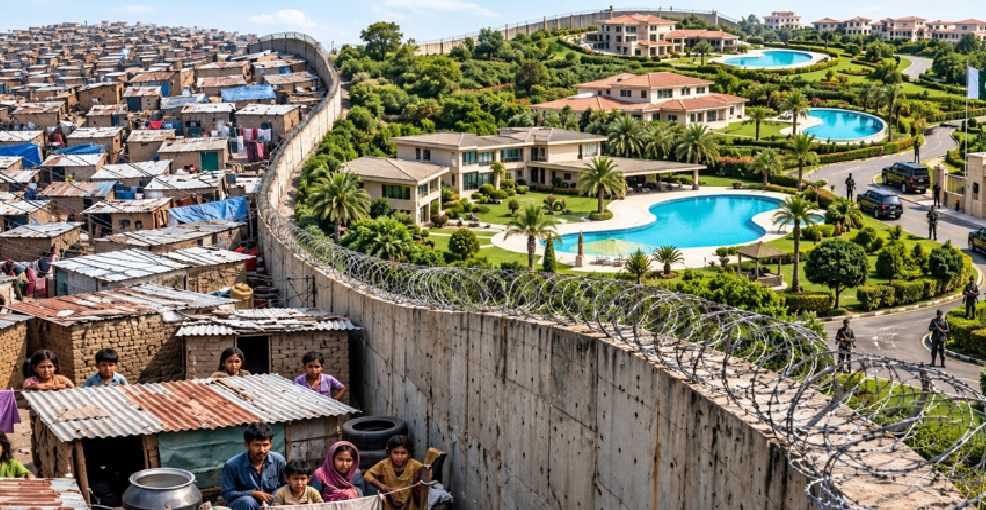
In Pakistan, military privilege does not end when an officer leaves the barracks. For senior officers, retirement can bring land, housing, commercial opportunities and a pathway into influential civilian positions. Behind the system stands an economic network that reaches deep into property, agriculture, logistics, banking, manufacturing and energy.
In January 2017, Pakistan’s military media wing confirmed that Gen. Raheel Sharif, who had retired as army chief only weeks earlier, had been allotted 90 acres of land near Lahore. The military said the allocation followed established rules and that army chiefs received similar benefits on retirement.
The episode was not presented by the military as an exception. It was presented as entitlement.
That distinction goes to the heart of Pakistan’s military-economic system: the issue is not simply whether individual officers receive benefits, but how an institution with enormous political and security power has accumulated extensive access to land, businesses and state-linked economic opportunities under a framework that remains difficult for the public to scrutinise.
A system with roots before Pakistan
The architecture is older than the country itself.
Under British rule, large areas of Punjab were transformed through canal irrigation and agricultural settlement. Land was distributed to soldiers and officers according to rank, creating a link between military service and access to valuable state-created assets.
Pakistan inherited much of that framework in 1947, including cantonment estates, land regulations and institutional practices that connected military rank with property.
In her 2007 book Military Inc.: Inside Pakistan’s Military Economy, scholar Ayesha Siddiqa described the phenomenon as “Milbus” — military capital controlled by serving and retired officers and insulated from ordinary systems of accountability. The concept encompasses economic activity associated with the military that falls outside conventional defence expenditure and normal government scrutiny.
Over time, the system expanded from land allocations into a sprawling network of commercial institutions.
When military privilege becomes family wealth
The controversy surrounding former army chief Gen. Qamar Javed Bajwa illustrates the intensity of the debate.
In November 2022, investigative outlet FactFocus published tax records concerning Bajwa’s family and reported that its assets had risen to about Rs12.7 billion during his six-year tenure. The military rejected the reporting as misleading. The government response focused on the disclosure of the tax records, with an inquiry ordered into the leak and tax officials suspended. The underlying allegations have not been established by a court.
The significance of the episode lies not only in the disputed figures but in the question it raised: how much can the public independently establish about the wealth of those at the apex of Pakistan’s military hierarchy?
That question is difficult to answer when financial records, property allocations and institutional dealings are not subject to the same degree of public disclosure expected elsewhere.
An army with a corporate footprint
Pakistan’s military influence extends far beyond defence.
The Fauji Foundation, Army Welfare Trust, Shaheen Foundation and Bahria Foundation operate across multiple sectors. The source material identifies military-linked interests in cement, banking, agriculture, dairy, transport and other industries, alongside extensive involvement in real estate.
These institutions have a legitimate stated purpose: supporting veterans, serving personnel and military families. The Fauji Foundation, for example, says its commercial activities finance welfare programmes.
But welfare does not eliminate the need for transparency.
The source material argues that the foundation’s structure leaves it outside disclosure requirements that apply to listed companies, making independent assessment of its finances more difficult.
The result is a recurring problem: the institutions themselves describe the benefits they provide, while outsiders can face significant difficulty independently examining the scale, beneficiaries and financial flows behind those claims.
Land remains the foundation of the system
Few areas illustrate the military’s economic reach more clearly than land.
Defence Housing Authorities operate major schemes in Pakistan’s largest cities. The system described in the source involves land acquired at government-assessed rates, subsequently developed and allocated or sold through military-linked housing structures. In Islamabad, the law reserves half of DHA plots for martyrs’ families, war-injured personnel and junior ranks.
Yet the source notes that without published independent audits, the public cannot readily verify how those allocations are implemented or whether the distribution corresponds to the stated rules.
The Okara dispute shows that the issue is not confined to urban property.
For generations, tenant families cultivated approximately 17,000 acres of state land under a crop-sharing arrangement. When authorities attempted around 2000 to replace the arrangement with short-term cash leases, the farmers resisted and faced arrests and blockades. The source says the army later acknowledged before the National Commission for Human Rights that the land belonged to the Punjab government and that it had used the property to grow fodder.
The controversy has since moved into a much larger arena.
Under the Green Pakistan Initiative, the military has assumed a leading role in corporate farming projects involving state land. The source material cites a potential footprint of up to 4.8 million acres, alongside arrangements involving more than 52,000 acres in Sindh and a disputed 45,000-acre transfer in Punjab.
The military’s justification is food security.
That argument has potentially far-reaching implications. If food security permits military management of large areas of agricultural land, the boundary between national defence and civilian economic administration becomes increasingly difficult to define.
From emergency logistics to permanent enterprise
The same pattern can be seen in logistics.
The National Logistics Cell was created in 1978 to address a port crisis in Karachi. The emergency passed, but the organisation remained and expanded into freight and construction.
Pakistan Railways, meanwhile, declined as a freight operator. In 2014, a Senate committee recommended transferring military freight operations back to the railway system. The recommendation went nowhere.
What began as an emergency arrangement had become a permanent institution.
That is a recurring feature of the military’s economic role: temporary necessity can become permanent commercial presence.
Retirement is not the end of the network
For senior officers, retirement can mark the beginning of another phase of influence.
Former military officers have moved into state companies, ministries, regulatory bodies and other public institutions. The source material describes this as part of a broader system in which military careers can lead directly into influential civilian and commercial positions.
The case of Lt. Gen. Asim Saleem Bajwa illustrates the scrutiny such networks attract. In 2020, FactFocus reported that relatives of Bajwa held stakes in 99 companies across four countries, including a pizza franchise operation. Bajwa denied wrongdoing and offered to provide his financial records. The source says no Pakistani court, regulator or anti-corruption body took up that offer and that much of the information became visible through foreign corporate registries.
Again, the allegations should not be confused with judicial findings. But the difficulty of independently testing them points to a larger institutional problem: where disclosure is weak, suspicion can thrive because the public lacks the records needed to settle the questions.
Even accountability can remain inside the military system
In December 2025, former Inter-Services Intelligence chief Lt. Gen. Faiz Hameed was sentenced by a military court to 14 years in prison following a court martial involving charges including political activity, misuse of authority and causing wrongful loss.
The conviction was significant, but the proceedings were closed. According to the source, the public record remained limited and Hameed’s lawyer disputed the proceedings. The case was connected to a civilian complaint involving the Top City housing scheme.
The case demonstrated that senior officers can face punishment. It also underscored another unresolved question: how much of the evidence and decision-making behind such proceedings can the public independently examine?
The real question is accountability
Pakistan’s military-commercial system cannot be reduced to a list of businesses or land grants. It is a structure in which military authority, public land, commercial enterprises and post-retirement privilege have become closely intertwined.
Supporters of military welfare institutions can point to the schools, hospitals and assistance provided to veterans and military families. Those functions have genuine social value.
But welfare cannot by itself answer questions about land, commercial holdings, preferential access, conflicts of interest or financial transparency.
The most basic demand is disclosure.
A comprehensive register of military landholdings, transparent records of property allocations, independently audited accounts for military welfare foundations and a public register of post-retirement appointments would make it possible to distinguish documented fact from allegation. The source material specifically identifies these records as key to resolving the debate.
Without them, the system remains unusually difficult to examine from outside.
The Pakistan Army may have built much of its economic empire through laws, regulations and officially sanctioned institutions rather than through clandestine transactions. That makes the question of accountability more important, not less.
The issue is ultimately straightforward: when an institution possesses the power to defend the state, influence its politics and control substantial economic assets, who independently audits the power that comes with the uniform?