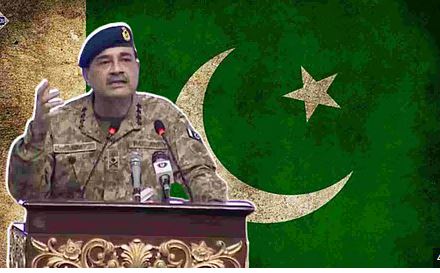
The promotion of General Asim Munir to the position of Pakistan’s Chief of Army Staff has been one of the most pivotal developments in South Asian geopolitics in recent times. While his ascent may appear as part of routine institutional progression, a closer and more critical academic inquiry suggests that the elevation is not only emblematic of the enduring power dynamics within the Pakistani military establishment but also indicative of a more personalist drive embedded in the matrix of military strategy and political manipulation.
The recent Pahalgam terror attack and the resurfacing of tensions between India and Pakistan cannot be fully understood without acknowledging the strategic orchestration that served to amplify Asim Munir’s profile and fortify his legitimacy as the only plausible candidate for the coveted role of Field Marshal, which he ultimately achieved, though as propaganda to cover up humiliation caused by India’s Operation Sindoor.
This argument does not rest solely on conjecture or coincidence but rather draws from the deeper theoretical understandings of power and perception in international relations. By analysing this development through the lens of realist scholarship and the constructivist school of thought, a clearer picture emerges of how self-interest, narrative construction, and elite manipulation converge to produce outcomes that shape the course of regional stability and military politics.
Strategic Conflict as a Tool for Institutional Advancement
From a realist perspective, particularly that of Hans Morgenthau’s classical realism, power remains the central concern of political action, and the pursuit of national—or, in this case, institutional—interest becomes the decisive factor in all strategic behaviour. Morgenthau asserted that political actors, whether state leaders or generals, are guided by a relentless quest for power maximisation and survival.
The rise of Asim Munir must therefore be evaluated not merely in the language of military merit or strategic necessity but rather as the outcome of an internal power calculus where elite positioning, narrative control, and manufactured legitimacy play dominant roles.
The Pahalgam attack, while outwardly appearing as an act of terror that disrupted regional peace, functioned politically as a catalyst in heightening tensions and drawing attention to the necessity of a strong, decisive, and experienced leader within Pakistan’s security apparatus.