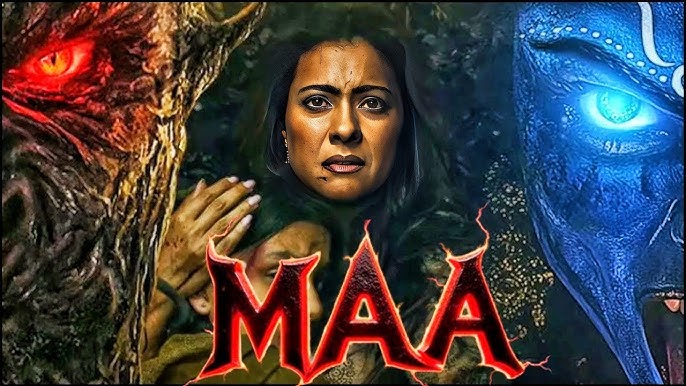
Kajol’s latest release Maa, directed by Vishal Furia, is a mythological horror fantasy that fails to capitalise on a story that could have been brought to light with an even bigger impact. The movie revolves around a plot that mixes mythology, fantasy, and horror all together. The story begins with an age-old tradition of sacrificing every girl child born within the royal family to seek protection from Goddess Kali against a monster who has been terrorising the area of Chandrapur in West Bengal, where the film is set.
Once the concept and the narrative of the movie is established, the story shows that Kajol and her husband, Shuvankar (Indraneil Sengupta), stay far away from Chandrapur. However, Shuvankar, who belongs to the royal family has a girl child with Kajol but hides it from his family to protect her from being killed as an act of sacrifice. Situations and circumstances quickly take a turn for the worse for Kajol and her daughter, who are left alone after the sudden death of Shuvankar, who visits Chandrapur after the demise of his father.
For almost 12 years since the birth of their daughter, Shweta (Kherin Sharma), Ambika (Kajol) and Shuvankar have kept her hidden from Chandrapur and have never visited the palace due to the family history. However, after Shuvankar’s death, Kajol is forced to visit Chandrapur and is forced to take her daughter along, who insists on visiting her father’s palatial house that is put up for sale.
Ambika learns a lot more about Chandrapur and the tales of the demon who resides there and is in disbelief with the mishaps that start happening ever since she sets foot in the palace with her daughter. And how she, as a mother, navigates through the horror is what makes up for the rest of the film.
The concept and story have substance, but the film lacked largely because of its style of storytelling. Besides, the film also has a lot of stereotypes that could have been done without. Besides the exaggeration that the palace had a almost 30-feet tall Kali maa’s stone carved statue, the way people from Chandrapur talk in the film, everything seems to be a cliche that all the Bengalis would be running away from. It only gets disappointing to see Ronit Roy, who plays a vital part in the film, deliver all his Hindi dialogues with such a heavy Bengali accent. A lot would argue that it is not how people from Bengal speak when they talk in Hindi.