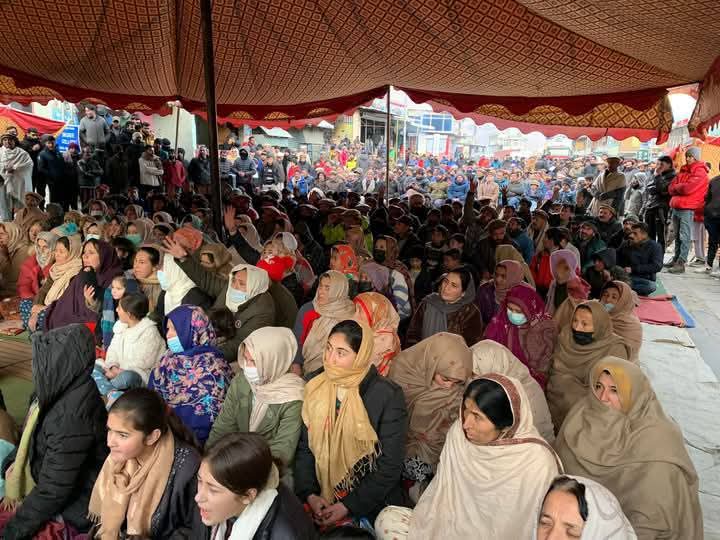
For the fifth straight day, Pakistan’s critical trade route with China, the Karakoram Highway, remains blocked as massive protests erupt in Hunza, located in Pakistan-occupied Gilgit-Baltistan (PoGB). Thousands of local residents, enduring freezing temperatures, have taken to the streets demanding an end to severe power shortages that have plunged the region into darkness for up to 23 hours a day amid the harsh winter.
The protests, which have seen significant involvement from women, political figures, and local businesses, reflect the growing frustration over Islamabad’s long-standing neglect of the region. Protesters have pledged to continue their sit-in until their demands are met, effectively halting trade along this vital route connecting Pakistan and China.
This ongoing crisis underscores the exploitative practices of the Pakistan Army and establishment in PoGB, which many view as a colony rather than an integral part of the country. Despite being home to essential trade routes and serving as a key access point for the China-Pakistan Economic Corridor (CPEC), PoGB’s residents are subjected to neglect, with little to no benefits from the region’s strategic importance.
The Pakistan Army, which exercises significant control over the region, has been criticized for prioritizing its own economic gains from CPEC while ignoring the basic needs of local populations. Promises of development tied to CPEC have not materialized for the people of PoGB, who face deteriorating infrastructure, environmental harm, and a declining standard of living.
The Struggle for Basic Needs in Hunza
Protesters have accused local authorities of failing to provide reliable electricity, even as winter temperatures plummet to -10°C at night. The region’s reliance on hydropower, which becomes nearly inoperative during the winter months when rivers freeze, has exacerbated the situation. Residents, many of whom live in poverty, have been forced to use costly thermal generators, further straining their already limited finances.
The protests also bring attention to the environmental impact of the increased use of generators, particularly by hotels and businesses, contributing to worsening air pollution in the region’s pristine mountainous landscape.
Despite attempts by local authorities to negotiate with demonstrators, no tangible solutions have been offered to restore power or reopen the Karakoram Highway. As a result, containers carrying goods between Pakistan and China remain stranded, causing disruptions to trade and highlighting the fragility of the “all-weather friendship” between the two nations.
CPEC’s Unfulfilled Promises and Exploitation
The protests have erupted just a month after Pakistan and China announced plans to keep the Khunjerab Pass open year-round in a bid to boost trade connectivity. However, this initiative has done little to address the deep-rooted grievances of the people in PoGB, who view CPEC as a project that benefits elites, both Pakistani and Chinese, at the expense of their local communities.
While PoGB holds significant strategic value to Pakistan, its residents continue to be treated as second-class citizens. The Pakistan Army, known for its colonial mindset, continues to exploit the region as a source of revenue while neglecting the basic needs of the population. As a result, the people of PoGB suffer from power shortages, poverty, and environmental damage, all while seeing little of the promised benefits of CPEC.