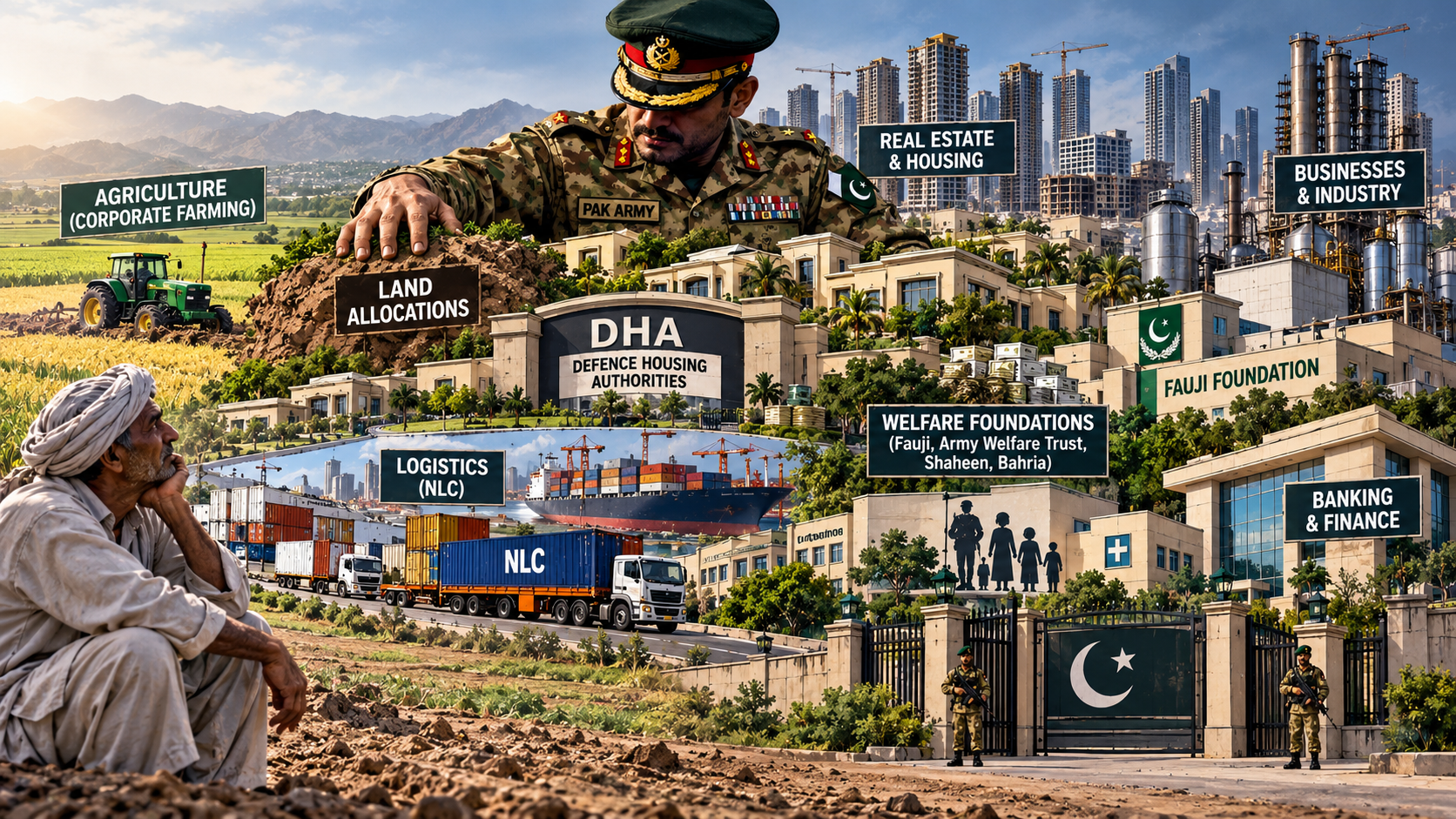
Pakistan’s military has built a substantial economic presence alongside its formal role as the country’s defence institution, with its interests extending into housing, agriculture, logistics, banking, manufacturing and other commercial activities, according to the material reviewed for this report. The system has developed through a combination of legislation, government notifications, welfare foundations and military-linked enterprises.
The scale of that economic footprint has raised questions over transparency, oversight and the relationship between military institutions and civilian economic activity. Senior officers have historically received agricultural land and residential plots, while military-linked housing authorities have developed large residential and commercial schemes in major Pakistani cities.
The Defence Housing Authorities, or DHAs, operate in Lahore, Karachi, Islamabad, Rawalpindi, Multan, Gujranwala and Quetta. The material describes a model in which land is acquired from farmers and other private owners at government-assessed rates before being developed into higher-value housing and commercial projects.
The legal framework governing DHA Lahore allows compulsory acquisition of land for what is described as a “public purpose”. The material also raises questions about the extent of independent financial oversight, noting that the relevant ordinance provides for auditing but does not specifically require an audit by the Auditor General of Pakistan.
Islamabad’s DHA framework includes provisions reserving a portion of plots for the families of military personnel killed in service, war-wounded soldiers and junior ranks. The material argues that the absence of a publicly available independent audit makes it difficult for outsiders to assess how such allocations are implemented.
Agricultural land has also been an area of contention. In Okara, tenant families cultivated about 17,000 acres of Punjab government land for decades under a crop-sharing arrangement. The material says that around 2000 the tenants were pressed to accept short-term cash leases, triggering protests and confrontations involving the Anjuman Mazarain Punjab.
The army subsequently acknowledged before the National Commission for Human Rights that the land belonged to the Punjab government and that it was being used by the military to grow fodder rather than held as military property, according to the material.
More recently, the military has taken a prominent role in corporate farming under the Green Pakistan Initiative. The project has involved plans covering potentially millions of acres of state land in Punjab and Sindh. The material says more than 52,000 acres in Sindh were earmarked for military-linked corporate entities on 20-year leases, while a proposed transfer of 45,000 acres was challenged in the Lahore High Court.
Military-linked commercial activity extends beyond land. The Fauji Foundation, established in 1954, has interests spanning fertiliser, cement, oil and gas, power, food, banking and port terminals. Other institutions identified in the material include the Army Welfare Trust, Shaheen Foundation, Bahria Foundation and the National Logistics Corporation.
These organisations have traditionally been presented as serving welfare purposes, including support for veterans, schools, hospitals and families of soldiers killed in service. The Fauji Foundation says its profits finance such activities. The material, however, points to differences between the disclosure requirements imposed on listed companies and those applying to the foundation under the Charitable Endowments Act of 1890.
The National Logistics Corporation provides another example of a military-linked enterprise that expanded beyond its original purpose. Established in 1978 during a port crisis in Karachi, the organisation developed into a large freight, construction and logistics operation and has been headed by serving military officers.
The economic role of military personnel can continue after retirement. According to the material, retired officers have been appointed to positions in government ministries, state-owned companies, regulatory bodies and diplomatic missions. Individual appointments are published through official notifications, but there is no consolidated public register allowing the scale of former military officers’ presence in civilian oversight positions to be readily assessed.
The material also cites cases involving the reported wealth and business interests of military families. In 2022, Fact Focus published tax records concerning the family of former army chief General Qamar Javed Bajwa and reported substantial growth in family assets during his tenure. The military disputed the reporting as misleading, and the material notes that the allegations were not tested by a court.
A separate Fact Focus investigation reported business interests involving the family of Lt Gen Asim Saleem Bajwa. Bajwa denied wrongdoing and offered to provide documentation of his financial transactions, according to the material.
Questions about accountability extend to the institutions responsible for investigating public officials. The material states that the National Accountability Bureau does not cover serving military personnel and that parliamentary committees have powers that are primarily recommendatory. It also points to constitutional changes in 2025 that, according to the document, extended legal immunity to the country’s highest military ranks.
For critics of Pakistan’s military-economic structure, the central issue is not the existence of welfare or commercial enterprises themselves but the degree of transparency surrounding their landholdings, finances, appointments and access to state resources.
The material proposes greater disclosure through a public register of military landholdings, a rank-by-rank record of land allotments, independently audited accounts for military welfare foundations and a consolidated register of post-retirement appointments. It also calls for stronger auditing of DHAs, competitive bidding for state logistics contracts and greater civilian oversight of military land administration.
The debate ultimately concerns how Pakistan balances the institutional needs of its armed forces with public accountability. Military welfare programmes provide benefits to veterans and the families of fallen and disabled personnel, while military-linked businesses operate across significant parts of the economy. The question raised by the material is whether those activities can be subjected to sufficient public scrutiny while preserving the welfare functions they were established to serve.