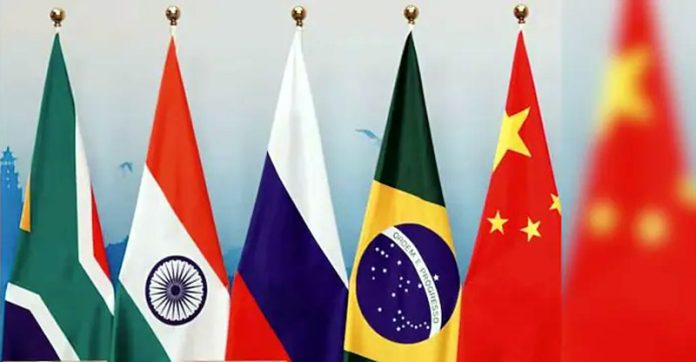
Twenty years after the BRIC grouping emerged, BRICS has grown into a major platform representing the shifting balance of the global economy, with increasing economic weight and a broader institutional role.
What began as an acronym coined by Goldman Sachs for Brazil, Russia, India and China has evolved into a wider grouping addressing trade, finance, development, technology, supply chains and global governance.
BRICS economies accounted for nearly 40 per cent of global GDP on a purchasing power parity basis in 2024, compared with about 29 per cent for the G7, according to IMF data. Intra-BRICS trade has also expanded sharply, rising more than 13-fold from USD 84 billion in 2003 to around USD 1.17 trillion in 2024, according to UN Trade and Development (UNCTAD). However, such trade still represents only about 5 per cent of global trade.
Senior journalist, educationist and researcher RN Bhaskar described BRICS as an initiative that originated as an “artificial construct of Goldman Sachs”, but said Russia recognised its potential to develop into a broader platform.
South Africa joined the grouping in 2010, followed by its more recent expansion to include Egypt, Ethiopia, Iran, Indonesia, the UAE and Saudi Arabia. The expansion has reflected the growing economic importance of emerging markets and their rising contribution to global growth, trade, manufacturing, commodities and investment.
The grouping has also become part of a wider push for greater political and institutional representation for emerging economies. Its significance lies not only in the creation of alternative financial institutions but also in the changing geography of global production and trade.
UNCTAD estimates that BRICS members’ merchandise exports increased from nearly USD 1 trillion in 2003 to around USD 6 trillion in 2024, while their share of global exports doubled from approximately 12 per cent to 24 per cent.
China remains the dominant trading power within the grouping. UNCTAD’s 2026 study identifies China as the largest exporter and importer in intra-BRICS trade, while several other members remain heavily dependent on BRICS markets.
Economist Manoj Pant, visiting faculty at Shiv Nadar University and former vice chancellor of the Indian Institute of Foreign Trade, said the expansion of intra-BRICS trade should not necessarily be interpreted as evidence of a deeply integrated economic bloc.
“China is central to the world trade,” Pant said, noting that a significant share of intra-BRICS commerce remains linked to China’s position at the centre of global supply chains.
While merchandise trade among BRICS members has grown substantially, Pant said investment was a more meaningful indicator of whether businesses genuinely view other member economies as part of their long-term economic ecosystem.
He pointed to the absence of deeper institutional, telecommunications and business links, particularly among smaller industries, as a constraint on the emergence of a fully integrated BRICS market.
“There are no institutional links among small-scale industries of BRICS countries,” he said.
China’s manufacturing base, export capacity and trading relationships provide an economic anchor for the grouping. While China can use BRICS to deepen its engagement with the Global South, commodity exporters gain access to major markets, while countries such as India and Brazil can use the grouping to diversify economic relationships and strengthen their collective voice.
The New Development Bank (NDB), established in 2014, is among BRICS’ most tangible contributions to the global financial architecture. Created outside the traditional Bretton Woods framework, the institution has expanded its membership and focused increasingly on infrastructure, sustainable development and local-currency financing.
At the 2025 BRICS Summit in Rio, leaders backed greater local-currency financing and diversification of funding sources, while highlighting the NDB’s role as an institution for the Global South.
The debate over reducing dependence on the US dollar has also become a prominent part of the BRICS agenda. Bhaskar argued that the use of sanctions, financial restrictions and the dollar-based financial system as instruments of geopolitical pressure has strengthened interest in alternatives.
“US sanctions are not working because of BRICS. Despite US sanctions, it is because of BRICS that this [investment] platform has been working,” Bhaskar said.
India has consistently supported greater representation for emerging economies in global institutions while maintaining strong links with Western markets, investment and technology. Under its 2026 BRICS chairship, New Delhi has focused on practical economic cooperation rather than a wholesale challenge to the existing global system.
At the 16th BRICS Trade Ministers’ Meeting in Jaipur, India pushed for a WTO-centred multilateral trading system, resilient and diversified global value chains, greater internationalisation of MSMEs, trade finance and cooperation in digitally delivered services. The meeting also advanced the “Strategy for BRICS Economic Partnership 2030”, covering trade, investment, services, the digital economy, innovation, financial cooperation and sustainable development.
BRICS’ longer-term significance may ultimately be as much political as economic. The grouping has helped turn demands for greater Global South representation into an organised institutional agenda.
The 2025 Rio Declaration called for reforms to the governance structures of the Bretton Woods institutions to reflect the growing weight of emerging-market and developing economies, as well as greater representation for developing countries in the IMF and World Bank. At the same time, BRICS reaffirmed its support for the WTO-centred multilateral trading system.
The grouping is therefore not necessarily seeking to dismantle the existing global economic architecture, but rather to alter the distribution of influence within it.
Bhaskar said the shift was part of a broader restructuring of global economic and financial flows, with more countries increasingly willing to conduct transactions in currencies other than the US dollar.
“Increasingly, more countries are now willing to enter transactions in non-dollar currencies,” he said.
For BRICS, the challenge over the next decade is no longer demonstrating the size of its economies, but building the deeper economic connections that its collective weight would suggest.
The grouping has contributed to a more multipolar global economy by increasing the visibility and bargaining power of emerging economies, creating institutions such as the NDB, expanding South-South trade and challenging the notion that global economic governance can remain centred exclusively on Western powers.
BRICS has not replaced the Western-led global economic order, but it has made that order less exclusively Western. Its economic weight is influencing global trade and investment patterns, while its institutions are beginning to offer alternatives at the margins and its political platform has strengthened the collective voice of the Global South.
The key unfinished task is to translate that collective weight into deeper economic integration. At 20, BRICS has changed the global economic conversation faster than it has changed the global economic architecture. The next two decades will determine whether it remains a powerful platform for a multipolar world or evolves into the integrated economic force its growing economic weight suggests it could become.