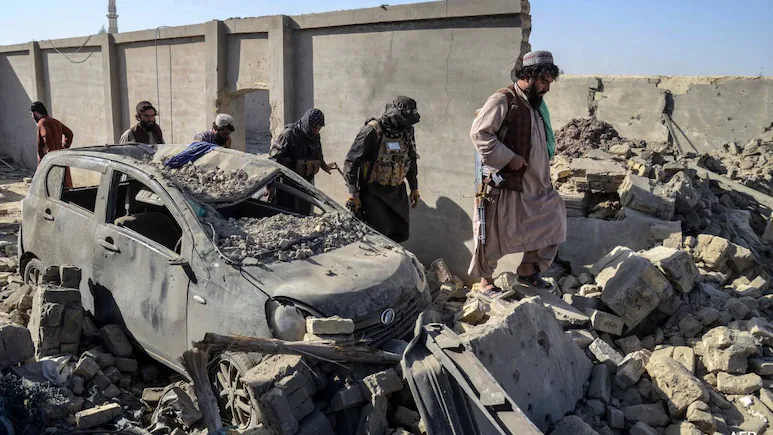
Pakistan’s air strikes inside Afghanistan are presented in the supplied material as part of a broader escalation linked to tensions along the border, Pakistan’s regional military commitments and mounting domestic political pressure. The material says the Pakistan Air Force targeted locations in Kunar, Paktika and Khost after reported Afghan drone incursions and the September 18 bombing in Kohat.
According to the document, Pakistani authorities portrayed the strikes as a response to security threats emanating from Afghanistan. It argues, however, that the scale of the response was disproportionate to the reported activity, describing three to four Afghan reconnaissance drones as the immediate trigger for a wider aerial campaign.
The material further alleges that Pakistani strikes hit civilian areas and caused deaths among women and children. Those allegations are presented in the document as evidence that the military response went beyond the stated objective of targeting militant positions.
A central part of the document’s argument concerns the September 18 suicide bombing at a police compound mosque in Kohat. It says 31 people were killed and more than 100 wounded, and alleges that the attack was deliberately orchestrated by Pakistan’s Inter-Services Intelligence agency in coordination with a militant group identified as Ittehad-ul-Mujahideen Pakistan.
The document characterises the Kohat attack as a “false flag” operation and argues that it was used to create a justification for military action against Afghanistan. These allegations are asserted in the source material but are not independently established within the document.
The report also links the Afghan escalation to Pakistan’s regional security commitments. It points to an August 2026 trilateral defence agreement involving Pakistan, Saudi Arabia and Türkiye, describing the arrangement as a framework under which Pakistan assumed collective-security obligations. The material says Pakistan also received financial support from Saudi Arabia in the form of loans, deferred oil arrangements and other assistance.
According to the document, the subsequent escalation on the Afghan frontier was intended to give Pakistan grounds to avoid involvement in potential fighting elsewhere in the region. It specifically refers to Iranian-backed Houthi drone attacks near Makkah and against Saudi infrastructure, arguing that a direct military response under the defence agreement could have exposed Pakistan to conflict with Iran and increased sectarian tensions inside the country. The document alleges that the Afghan confrontation therefore provided Islamabad with a justification for keeping forces focused on its western frontier.
The domestic political dimension is another major element of the source material. It connects the border escalation to a Pakistan Tehreek-e-Insaf, or PTI, long march scheduled for September 27, 2026. The document alleges that the military establishment sought to use the security situation to restrict the planned mobilisation and divert public attention from demands concerning the release of former Prime Minister Imran Khan and the political role of the military.
It cites measures including restrictions on highways, the imposition of Section 144 in parts of Islamabad and Punjab, telecommunications disruptions and arrests of political activists. The material presents these actions as part of a broader effort to contain the PTI mobilisation under the justification of national security.
The document also alleges that Pakistan’s intelligence establishment could seek to exploit tensions between the PTI’s political base in Khyber Pakhtunkhwa and the wider Pakistani population. It claims that violent incidents during protests could be attributed to militants operating from Afghanistan, potentially allowing the authorities to portray political unrest as a cross-border security threat.
That allegation forms part of the source’s broader argument that the Afghan confrontation could serve both external and domestic political purposes. It does not provide independent evidence establishing that such attacks were planned or that Pakistani intelligence agencies intended to carry them out.
The supplied material ultimately portrays the air strikes as the product of overlapping pressures: the security confrontation with Afghanistan, Pakistan’s obligations under its regional defence arrangements and domestic political tensions surrounding the PTI. It argues that these factors created incentives for Islamabad to maintain an elevated state of security alert.
Several of the document’s most serious assertions — including claims that the Kohat bombing was orchestrated by intelligence agencies and that future violence against the PTI march would be deliberately engineered — remain allegations within the supplied material rather than independently demonstrated findings. The document cites academic and policy sources including Christine Fair, the International Crisis Group, Ayesha Siddiqa, the South Asia Terrorism Portal and Brookings Institution, but the supplied text does not set out the underlying evidence from those sources.