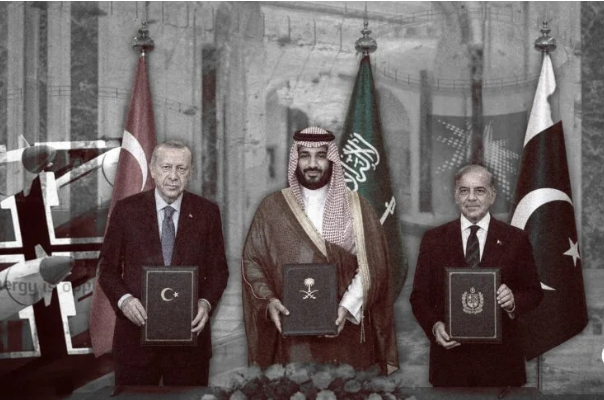
Pakistan’s sweeping commitment to defend Saudi Arabia is facing its first serious test as escalating Houthi attacks on the kingdom force Islamabad to reconcile the language of collective defence with a competing strategic imperative: avoiding direct military confrontation with Iran and another war in Yemen.
The pressure has grown sharply since Pakistan, Saudi Arabia and Türkiye signed the Makkah Joint Defence Agreement on August 7. The agreement declares that an armed attack against one member will be considered an attack against all three, creating a collective-defence commitment at a time when the security environment around the Gulf and Red Sea is deteriorating.
Pakistan has left little ambiguity about its political commitment to Riyadh.
Defence Minister Khawaja Asif said this month that unprovoked aggression against Saudi Arabia could make the agreement operational and that Pakistan was bound to honour its terms. Pakistani military officials subsequently said Islamabad would go to “any extent” to defend the kingdom.
The operational response has been considerably more cautious.
Asked on September 10 whether Pakistan was considering military action against the Houthis, the Foreign Ministry said no such military response had been discussed. Instead, Islamabad emphasised dialogue, diplomacy and regional de-escalation while reiterating what it called its “unwavering support” for Saudi sovereignty and security.
That distinction has become harder to maintain as the attacks intensify.
The Houthis have struck Saudi cities and infrastructure with missiles and drones. Saudi Arabia said it intercepted a ballistic missile targeting Riyadh on September 19, the first such attack on the capital during the latest escalation. Riyadh has also reported an attempted Houthi drone attack towards Makkah, while the group has claimed attacks on other Saudi targets.
Pakistan condemned the attempted attack on Makkah in unusually strong language. Foreign Minister Ishaq Dar said Islamabad stood firmly with Saudi Arabia in protecting the Two Holy Mosques and the security of pilgrims, citizens and residents.
Yet Pakistan has so far stopped short of announcing combat operations against the Houthis.
The difference between its declarations and its actions does not necessarily mean Islamabad is refusing to honour the pact. The agreement does not appear to require an automatic, predetermined military response. The extent and form of assistance are subject to consultation among the members, according to analysis by the International Institute for Strategic Studies.
Pakistan also already has a separate Strategic Mutual Defence Agreement with Saudi Arabia. Its Foreign Ministry confirmed on September 17 that Pakistani forces had been deployed under bilateral arrangements, while declining to discuss operational details.
The harder question is whether Pakistan would move from strengthening Saudi defences to directly attacking Houthi positions in Yemen.
That decision would carry consequences far beyond the battlefield.
The Houthis are aligned with Iran and receive support from Tehran, although the degree of Iranian operational control over individual Houthi decisions remains disputed. Iran says Ansar Allah, the movement’s formal name, acts independently. Analysts generally distinguish between Iranian influence and direct command of the organisation.
For Pakistan, that distinction offers limited strategic comfort. An attack on the Houthis by Pakistani forces could still be interpreted in Tehran as Islamabad joining the opposing side of a regional conflict.
Recent diplomacy suggests Pakistani officials understand the risk.
Field Marshal Asim Munir has maintained direct contact with Iranian Foreign Minister Abbas Araghchi as tensions between Saudi Arabia and the Houthis have risen. Al Jazeera reported that Munir had travelled to Tehran four times since April and that telephone contacts between Pakistani and Iranian officials intensified during the latest escalation.
Islamabad has meanwhile avoided confirming reports that it conveyed a Saudi warning asking Tehran to restrain the Houthis. The Foreign Ministry called the reporting unsubstantiated and also dismissed as hypothetical reports that Riyadh had asked Pakistan to strike Houthi targets. It repeatedly returned instead to the language of dialogue and diplomacy.
That is not simply diplomatic caution.
Pakistan shares a roughly 900-km border with Iran through Balochistan, where Islamabad is already confronting a persistent insurgency. The two countries have previously exchanged strikes against militant targets across their frontier. A breakdown in relations with Tehran would therefore create direct security implications for Pakistan in addition to the consequences of becoming involved in Yemen.
There is also a domestic precedent.
When Saudi Arabia sought Pakistani military participation against the Houthis in 2015, Pakistan’s parliament unanimously backed neutrality in the Yemen conflict while supporting Saudi territorial integrity. The decision reflected concern about becoming entangled in a regional and sectarian confrontation.
The Makkah agreement makes that balancing act more difficult because Pakistan has now placed a formal collective-defence commitment alongside its longstanding political assurances to Riyadh.
The pact itself was publicly celebrated in Pakistan. Government ministers presented it as evidence of deeper strategic cooperation among the three Muslim-majority states. Foreign Minister Dar described it as purely defensive and said it was not directed against any particular country.
Recent events are exposing the ambiguity contained in the word “defensive”.
Protecting Saudi airspace, supplying air-defence systems, intelligence or technical assistance and deploying forces inside Saudi Arabia could all be described as defensive measures. Conducting air strikes against Houthi positions inside Yemen would represent a materially different level of involvement.
Türkiye has indicated that it could provide military assistance to meet Saudi requirements under the agreement. Turkish Foreign Minister Hakan Fidan said Ankara was prepared to help with technical military needs, while also supporting diplomatic efforts to contain the conflict. Pakistan, by contrast, has yet to specify publicly what assistance it would provide if the Houthi campaign continues.
The Houthis have noticed that ambiguity.
Senior Houthi figure Mohammed al-Bukhaiti has warned Pakistan and Türkiye against military intervention on Saudi Arabia’s behalf, according to regional reporting, threatening retaliation if either enters the conflict.
Discussion on X has increasingly focused on precisely this question: whether the collective-defence language of the Makkah agreement will translate into Pakistani combat operations or remain primarily a deterrent and diplomatic commitment.
Official Pakistani posts have emphasised solidarity with Saudi Arabia, regional security and the defensive character of the pact. Iranian-linked commentary has stressed Houthi battlefield gains and resistance to Saudi pressure. The competing narratives are important, but neither establishes what Pakistan has actually agreed to do operationally if Riyadh formally requests combat assistance.
The institutional architecture of the pact itself is still developing. Pakistan’s Foreign Ministry said on September 17 that further meetings would be held to establish mechanisms for implementing the agreement. Questions about its secretariat and other arrangements had not yet been settled.
That leaves a significant gap between the clarity of the political promise and the mechanics of fulfilling it.
The Makkah agreement says an attack on one member is an attack on all. It does not mean that every attack automatically produces the same military response from every signatory. The current crisis is demonstrating how much room remains between those two propositions.
For Islamabad, that room is strategically valuable.
Pakistan wants Saudi Arabia to believe its security commitment is credible. It wants Iran to understand that the agreement is not an anti-Iranian military alignment. It wants to preserve its ability to communicate with Tehran and potentially mediate, while simultaneously assuring Riyadh that Saudi territory will be defended.
Those objectives can coexist while Pakistan’s contribution remains diplomatic, defensive or logistical. They become considerably harder to reconcile if Pakistani aircraft or troops begin attacking an Iranian-aligned movement inside Yemen.
The issue therefore goes beyond whether Pakistan is willing to defend Saudi Arabia. Islamabad has repeatedly said that it is.
The unanswered question is what Pakistan considers defence.
If protecting Saudi territory can be achieved through air defence, deployments inside the kingdom, intelligence cooperation and diplomacy with Tehran, Islamabad may be able to honour the pact without entering the Yemen war. If Riyadh eventually seeks direct Pakistani military action against the Houthis, Pakistan will face a choice the Makkah agreement has so far allowed it to postpone.
That would turn a carefully worded collective-defence commitment into a much harder test: how far Islamabad is prepared to go for Riyadh when doing so risks confrontation with Tehran.