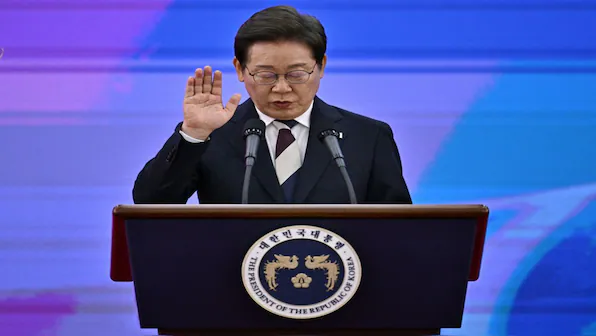
Lee Jae-myung of the liberal Democratic Party of Korea (DPK) is the new occupant of Cheong Wa Dae, the presidential palace in Seoul, also known as the Blue House. He won the snap presidential election on June 3. Lee succeeds Yoon Suk-yeol, the now-disgraced former president from the conservative People Power Party (PPP), whose short-lived declaration of martial law in December led to his impeachment and unanimous removal from office by the Constitutional Court.
With Lee’s election, the chaos, confusion, and confrontation that have defined the past six months in South Korea has supposedly ended. But has it really? I’ll answer that shortly.
Key Issues in the Election
The presidential election wasn’t due until 2027 and wouldn’t have happened this early under normal circumstances. But that changed on the night of December 3, 2024, when former President Yoon shocked the nation by declaring martial law. The move triggered mass protests, and on December 14, parliament voted to impeach him.
Under the South Korean Constitution, a snap election must be held within 60 days of the Constitutional Court upholding the impeachment and formally removing the president.
Given this backdrop, Yoon’s failed martial law bid became the defining issue of the election, pushing all others to the sidelines. Lee campaigned on promises to strengthen democracy and heal a divided nation. He also vowed to prosecute those involved in Yoon’s martial law attempt and implement stricter limits on a president’s ability to declare such powers.
However, other pressing issues remain for Lee to address, without the typical two-month honeymoon period usually granted to South Korean presidents. These include a faltering economy, spiraling prices, the unpredictable trade policies of Donald Trump, worsening ties with North Korea, and the delicate balancing act between China—South Korea’s biggest trading partner—and the US, its key strategic ally.
A Foregone Conclusion
Because the election was framed from the start by the failed martial law, the People Power Party was on the defensive. The result, therefore, felt like a foregone conclusion. Unsurprisingly, it unfolded along expected lines.
Lee Jae-myung of the DPK was elected the 21st President of the Republic of Korea, defeating Kim Moon-soo of the ruling PPP.
Here’s what happened:
According to the National Election Commission (NEC), 79.4 per cent of the country’s 44.4 million eligible voters cast their ballots—the highest turnout since the 1997 presidential election. Lee Jae-myung secured 49.4 per cent of the vote. Kim Moon-soo of the PPP came second with 41.2 percent. Lee Jun-seok of the Reform Party, a PPP splinter group, received 8.3 percent. Kwon Young-guk of the hastily formed Democratic Labor Party trailed far behind with 1 percent.
Strongest in Decades
When Lee lost the 2022 presidential election to Yoon Suk-yeol by the narrowest margin in South Korea’s democratic history (47.83 per cent to 48.56 per cent), many declared his political career over.
But just a year later, in the 2024 legislative elections, he led his party to a resounding victory, securing 173 seats—a two-thirds majority. When Yoon declared martial law on December 3, Lee seized the moment. He stormed the National Assembly in a dramatic late-night session to pass a resolution opposing the declaration, forcing Yoon to reverse his decision within hours. Lee’s popularity surged, and, as widely expected, the 61-year-old was swiftly inaugurated on Wednesday, June 3.
In a rare occurrence, Lee and his party now control both the presidency and parliament. This dual control makes him one of the most powerful presidents in South Korea’s democratic history. It could prove to be a double-edged sword—more on that later.
For now, a unified government offers Lee an opportunity to govern assertively until the next legislative election in 2028. He won’t need many conservative votes to advance his agenda, while the conservative party itself is mired in internal crisis.
The Reality Bites
Lee’s victory might have seemed inevitable given the conservatives’ disarray. The PPP was so divided it struggled to even nominate a candidate before settling on Kim, a former leftist turned far-right firebrand.
Given these dynamics, the PPP should have suffered a crushing defeat. But it didn’t. And that’s the sobering reality.
South Korea remains politically fractured, and the post-election crisis is as serious as it was before—if not more so.