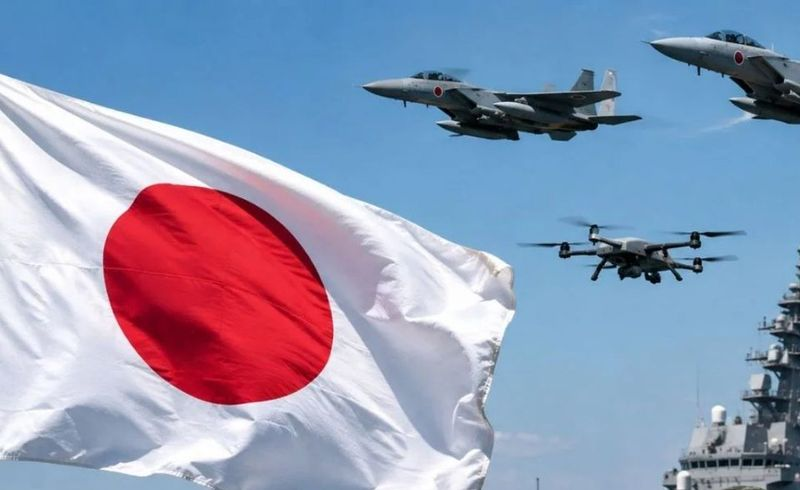
Japan has unveiled its 2026 Defence White Paper, outlining a major military transformation aimed at strengthening deterrence, expanding advanced defence technologies and preparing for prolonged conflicts, as Tokyo warned that the security environment around the country has become the most challenging since the end of World War II.
The annual report by Japan’s Ministry of Defense highlighted growing concerns over China’s military expansion, North Korea’s nuclear and missile programmes, and Russia’s increasing military cooperation with China and activities in the Indo-Pacific.
Japan Defence Minister Shinjiro Koizumi said the country must urgently strengthen its defence capabilities in response to rapid changes in modern warfare.
“The security environment surrounding Japan is as severe and complex as it has ever been since the end of World War II,” Koizumi said in his message accompanying the white paper.
The report said that since the adoption of Japan’s “Three Strategic Documents”, including the National Security Strategy, challenges to the international order based on the rule of law have intensified.
“In the Indo-Pacific, not only are China and North Korea further strengthening their military capabilities, China-Russia and Russia-North Korea are also reinforcing their cooperation,” the white paper said.It added that lessons from Russia’s war in Ukraine had accelerated preparations worldwide for “new ways of warfare”, including the “mass employment of unmanned assets” and the ability to sustain long-term military operations.
The white paper described China’s military activities and external posture as Japan’s “unprecedented and greatest strategic challenge”, warning that Beijing has continued to rapidly expand its military capabilities.
“China’s external posture, military activities, and other activities are a matter of serious concern for Japan and the international community and present an unprecedented and the greatest strategic challenge which Japan should respond to with its comprehensive national power,” the report said.
Japan said China has increased defence spending for more than three decades without sufficient transparency while rapidly improving its nuclear, missile, naval and air capabilities.
The report highlighted increased Chinese military activity around Japan, including in the East China Sea, waters near the disputed Senkaku Islands, the Sea of Japan and the western Pacific.
Tokyo also cited recent incidents involving Chinese military aircraft and Japanese Self-Defense Forces aircraft, including what it described as “unusual close approaches” and radar illumination incidents.
“Such unusual close approaches by Chinese military aircraft could have triggered an accidental collision,” the white paper said, adding that radar illumination by Chinese aircraft was “a dangerous act exceeding the range necessary for the safe flight of an aircraft.”
Japan also raised concerns over China’s military pressure around Taiwan, saying Beijing has intensified exercises in surrounding waters and airspace while seeking to improve its combat capabilities.
The white paper described North Korea’s military activities as an increasingly serious and imminent threat to Japan’s national security.
“North Korea’s military activities pose an even more grave and imminent threat to Japan’s national security than ever before,” the report said.
Japan said North Korea has conducted six nuclear tests and is believed to have the capability to mount nuclear warheads on ballistic missiles capable of reaching Japan.
The report said Pyongyang has accelerated missile development, including weapons with irregular trajectories, hypersonic missiles and long-range cruise missiles.
It also warned that growing military cooperation between North Korea and Russia could strengthen Pyongyang’s military capabilities over the medium and long term.
Japan said Russia’s military activities in the Indo-Pacific, combined with its strategic partnership with China, represent a significant security concern.
“Russia’s military activities in the Indo-Pacific region, including Japan, coupled with its strategic partnership with China, are posing a strong security concern,” the white paper said.
Tokyo also pointed to Russian military deployments in the Northern Territories, which Japan claims as its territory, including new military equipment and expanded facilities.
Japan said it was accelerating efforts to meet its target of raising defence spending to 2 per cent of GDP.
“In the FY2026 budget, expenditures, inclusive of expenses related to the Special Action Committee on Okinawa (SACO) and the realignment of US Forces in Japan, exceeded 9 trillion Yen for the first time,” Koizumi said.
The government plans to revise its three key security documents ahead of schedule this year as part of efforts to reshape Japan’s defence posture.
The white paper said Japan must “further reinforce and transform its defence capabilities with a stronger sense of urgency and crisis than ever before.”
A major focus of the report is adapting to new forms of warfare shaped by technology. The white paper said the Ukraine war demonstrated how large numbers of low-cost drones, artificial intelligence, cyber operations, and information warfare are changing battlefields.
“A mass quantity of diverse, inexpensive unmanned assets has been deployed on the battlefields of Ukraine,” the report said, adding that drones have been used against expensive military equipment, infrastructure, and in coordinated attacks.
Japan said future conflicts would increasingly involve space, cyber, and electromagnetic domains, alongside AI and quantum technologies.
“Decision-making using AI and networks has accelerated,” the report said, warning that cyberattacks, deepfakes, and AI-generated content are becoming growing security challenges.
Japan also highlighted defence production and technological development as key elements of national security.
“Defence production and technological bases are a virtually integral part of defence capability itself, and their reinforcement is indispensable,” the report said.
The ministry said it would increase cooperation with companies, startups, and research institutions to develop advanced technologies and strengthen domestic defence supply chains.
The white paper reaffirmed the importance of Japan’s alliance with the United States.
“The Japan-US Alliance is a key pillar of our national security policy,” Koizumi said. Japan said it would continue expanding security cooperation with the US, Australia, South Korea, the Philippines, ASEAN countries, and NATO partners to build a “Free and Open Indo-Pacific”.
The report stressed that regional stability cannot be achieved by Japan alone and called for stronger networks among allies and like-minded countries.
The defence buildup marks Japan’s biggest military expansion since World War II, as Tokyo seeks to balance growing security concerns with economic pressures and public finance challenges.