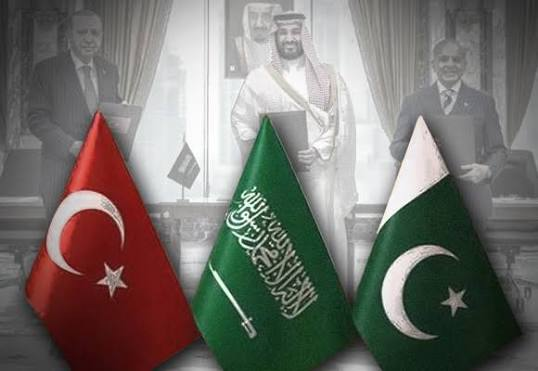
Saudi Arabia, Pakistan and Turkey have moved to activate their joint defence agreement, announcing immediate steps to prepare and deploy military forces and defence assets to Saudi Arabia amid growing regional tensions.
The decision was taken after emergency talks in Riyadh involving senior political and military officials from all three countries. The move comes as Yemen-aligned Houthi forces intensify cross-border missile and drone attacks, including strikes targeting Saudi territory, energy infrastructure and other strategic sites.
Khalid bin Salman, the defence minister of Saudi Arabia, announced the activation of the pact on X.Pakistan also issued an official statement on the activation of the pact.
The Mecca Joint Defence Agreement, signed on August 7, is modelled in part on the North Atlantic Treaty Organisation’s (Nato) Article 5 principle. Under the pact, an armed attack against one member is treated as an attack against all three, creating a framework for collective defence.
The agreement had initially faced questions over how quickly it could be put into action. But the escalation in regional hostilities has now pushed the three countries to begin implementing its defence commitments.Emergency talks in Riyadh
Monday’s meeting brought together senior foreign and defence officials from Saudi Arabia, Pakistan and Turkey.
Those attending included Turkish Foreign Minister Hakan Fidan and Defence Minister Yasar Guler, Pakistan’s Foreign Minister Ishaq Dar, Defence Minister Khawaja Asif and Army Chief Field Marshal Asim Munir, along with senior Saudi officials.
Following the talks, the pact’s Strategic-Political and Defence Committee agreed to move “immediately to the practical implementation” of the mutual defence commitments, according to a joint statement.
The agreement now moves beyond being a political commitment, with the three countries expected to coordinate the deployment of military personnel and defence systems.What Saudi Arabia, Turkey and Pakistan bring
The pact brings together three major military and economic powers with different strategic strengths.
Saudi Arabia provides the geographical base for the alliance, along with its economic resources and control of key energy infrastructure and regional transport routes.
Turkey brings a large defence industry and Nato-standard military capabilities. Its aerospace sector and drone technology could add significant capabilities to Saudi Arabia’s existing defence systems.
Pakistan contributes a large conventional military, extensive operational experience and expertise in air defence and strategic security.
The deployment of Turkish and Pakistani military assets could therefore strengthen Saudi Arabia’s ability to protect its territory, energy facilities and other critical infrastructure from missile and drone attacks.
This fight goes back to Yemen’s long war
The Houthi attacks on Saudi Arabia are tied to the decade-long war in Yemen.
The Iran-aligned group seized large parts of Yemen, including the capital Sanaa, in 2014. A year later, Saudi Arabia intervened militarily to support Yemen’s internationally recognised government and push back the Houthis.
The fighting eased after a UN-brokered truce in 2022, but it never fully went away. Tensions have risen again as Saudi-backed Yemeni forces step up efforts to regain territory from the Houthis, prompting the group to retaliate with missile and drone attacks on Saudi targets.
The Houthis have also targeted shipping in and around the Red Sea as part of their wider regional campaign. Their attacks have brought Saudi Arabia back into the crosshairs, particularly as Riyadh continues to support forces fighting the group inside Yemen.